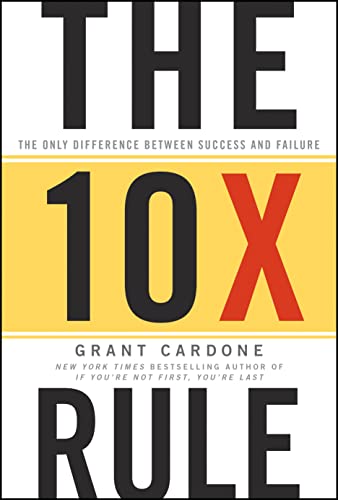
The 10X Rule
Every claim traces back to Cardone's own sales and real estate career. No external research is cited, no data is presented, and the 10x multiplier is asserted as conviction rather than derived from evidence.
The 10x heuristic is immediately applicable as a mental reset — multiply your goals by 10, multiply your current activity by 10 — but the book provides no differentiated protocols for how to actually execute more across different roles, industries, or resource constraints.
The core insight — underestimators fail, massive actors win — restates a principle common to sales and peak-performance literature going back decades. Cardone's delivery is confident and memorable, but the underlying idea is not original.
Core Thesis
"Most people fail not because they lack talent but because they set ordinary goals and take ordinary action — and both are catastrophic errors; success demands 10x the ambition and 10x the execution, applied until the result is unavoidable."
Verdict
- Must read for/if: Sales professionals, early-career operators, and anyone who has been told “you’re trying too hard” — or who has plateaued at a level of results they can’t explain by effort alone. The book’s core argument is a corrective for chronic underestimation: if your current approach to goals and activity produces a ceiling you can’t break through, the 10x frame provides a multiplier that resets your operating baseline. Also useful for managers who need to reset a team’s ambition after a sustained period of modest targets.
- Skip if: You’re already operating at high volume and need a strategy upgrade, not a motivational override. The book offers nothing for someone whose problem is bad targeting, weak positioning, wrong market, or insufficient resources. Also skip if you expect evidence-based reasoning — there is none.
- Core business value: The 10x frame solves one specific problem: most people set targets at the level they believe is achievable, then take action at the level they believe is sufficient, and both assumptions are almost always conservative. The book’s practical contribution is a calibration reset: multiply both by 10 and treat the discomfort that follows as signal, not obstacle.
- The reviewer’s take: The 10X Rule is a motivational stance packaged as a system. Its core correction is real — underestimation is a genuine pattern in how people set goals and execute — but Cardone offers no mechanism for diagnosing why someone underestimates, no framework for calibrating the multiplier to different contexts, and no evidence that 10x is the right number rather than 5x or 20x. The book works as a permission slip for people who’ve been told to be more modest; it fails as an operating manual for anyone whose constraint is strategy rather than effort.
Core Concepts
The 10X Rule rests on a single diagnostic claim: most underperformance is a failure of scale, not capability. People don’t set goals at the level of what they want — they set goals at the level of what seems reasonable, then discount further for what seems achievable without embarrassment. The result is targets sized for the average, fueled by average effort, producing outcomes slightly below what the person hoped for. Cardone’s solution is blunt: multiply both dimensions by 10.
The Four Degrees of Action. Cardone defines four distinct approaches to any situation, and argues that most people operate in the bottom two:
- Do Nothing — passively waiting for conditions to improve, for the right moment, or for someone else to create an opening. Not rest; abdication.
- Retreat — pulling back from a challenge, reducing exposure to failure by reducing exposure to opportunity. The “safe” choice that guarantees stagnation.
- Normal Action — the operating level of most professionals. Average goals, average effort, and the predictable result: slightly below what the person hoped for, because average action in a competitive environment is losing action.
- Massive Action — the fourth degree. Volume, visibility, persistence, and the refusal to treat previous effort as sufficient. This is the only level Cardone considers viable.
The 10x multiplier is not derived from evidence. Cardone never argues that ten is mathematically correct. The number is a psychological override: set a goal that would require you to become a different person to reach it, then take far more action than you believe is necessary. The discomfort is proof you’ve set the target correctly.
Success as duty. This is the book’s most distinctive claim — and the one that separates it from standard sales motivation. Cardone frames success not as personal aspiration but as obligation: to family, to community, to the full deployment of your capacity. Refusing to reach your potential, in this frame, is a form of negligence rather than modesty. The person who stays small because they don’t want to seem ambitious is not being humble; they’re opting out of a responsibility.
Dominate, don’t compete. Cardone draws a sharp distinction between competing (accepting that winning is uncertain) and dominating (taking sufficient action to make the outcome unavoidable). The strategic implication is volume: be so visible, so active, and so persistent across so many channels that the market encounters you constantly. This is the closest the book gets to a strategic frame rather than a motivational posture.
Case Discipline. Cardone’s evidentiary base is almost entirely his own career: breaking into car sales, building Cardone Enterprises, building a real estate portfolio across several decades. The secondary example that appears most frequently is a pharmaceutical sales team he trained that increased activity metrics significantly and saw corresponding revenue growth — presented as confirmation of the thesis. What the case actually proves is that the team was operating well below its activity ceiling. Whether the gains trace specifically to the 10x multiplier or to any significant increase in activity is not separated in the account. Cardone presents it as proof of the formula; it is more accurately evidence of underutilized capacity.
Evidence Quality. The 10X Rule contains no research citations, no controlled comparisons, and no external data. Every claim traces back to Cardone’s personal sales experience or anecdote-level observations from client engagements. The 10x multiplier is an assertion stated with conviction — illustrated with examples but never derived. Cardone is reporting what worked in his specific context and arguing by extension. The framework may be directionally correct as a corrective for underestimation bias. Whether 10x specifically is the right multiplier, whether it transfers across industries, and whether volume-first approaches succeed when strategy and market fit are the actual constraints — none of these questions are addressed.
Practical Applications
| Concept/Dysfunction | Organizational Symptom / Trigger | Leadership Intervention (The Play) |
|---|---|---|
| Operating at normal action levels | Team consistently misses targets by 10–15%; activity metrics are flat quarter over quarter; people blame market conditions rather than input volume | Audit current activity metrics (calls made, proposals sent, demos run, follow-ups completed). Set a target 10x the current baseline for one quarter. Do not change strategy — change volume. Measure whether the ceiling moves. |
| Goals sized for “reasonable” | Annual targets are set by averaging last year’s performance plus an incremental growth assumption; people feel neither stretched nor motivated | Require each person to write down the goal they would set if they were not afraid to fail. Multiply it by 10 and commit to that number. The discomfort in the room is the signal you’ve set the right target. |
| Retreat at first rejection | After a “no,” reps withdraw; the funnel narrows sharply at the second and third contact points | Track contact attempts 2–5, not just first outreach. Show the team conversion data comparing first-touch-only closes vs. multi-contact closes. Most closed deals require multiple contacts; a team stopping at one is systematically underselling its actual close rate. |
| Competing instead of dominating | Sales and marketing presence is reactive — defending existing accounts, matching competitors’ moves, maintaining rather than expanding visibility | Map every channel where your category competitor appears (social, search, events, PR, cold outreach). Build presence in every channel at a volume that makes your brand unavoidable. Out-appear competitors; do not try to out-think them at lower volume. |
| Fear treated as a stop signal | Team avoids the largest accounts, the hardest prospects, the highest-stakes pitches; “we’re not ready” becomes a chronic deferral | Run a “fear list” exercise: each person writes the three calls or opportunities they’ve been avoiding because they feel risky. Those items become the week’s first priority, not deferred items. Fear in this context signals where the opportunity is — not whether action is warranted. |
Practical Tips
-
Run a 10x goal audit: Write your current target for one domain — revenue, pipeline, clients, whatever matters most. Multiply it by 10. Then ask: what would have to be true for me to reach that number? The plan you build to answer that question is more useful than the original target, even if you never reach the 10x figure — because the thinking it forces produces a different operating approach. If this exercise produces no new ideas or changes to your approach, the constraint is not ambition. It’s strategy or resources. More volume won’t fix it.
-
Triple your primary activity volume for one week without changing strategy: Don’t change your pitch, your targeting, or your goals. Just triple the number of outreach attempts, proposals, follow-up calls, or whatever your primary growth activity is. Measure outcomes at week’s end. If output does not move when volume triples, your constraint is conversion rate or message quality — not effort. That tells you exactly where to work next.
-
Make a “biggest possible” list: Identify the three accounts, opportunities, or goals you’ve been avoiding because they feel too large, too risky, or too unlikely. Schedule outreach to the largest one this week — not next quarter, this week. If two weeks pass without contact, you’ve identified a real avoidance pattern. That’s more useful to know than to rationalize.
-
Track rejections for one month as activity data: For most sales environments, the people with the most rejections are also the people with the most wins — because volume is the underlying variable. If your rejection count is low, your activity count is also low. If you accumulate a high rejection count but wins don’t improve, the constraint has shifted from activity to message or targeting. The 10x approach has now diagnosed its own limits.
Critical Analysis
The 10X Rule is a useful motivational corrective for a genuine pattern — chronic underestimation in goal-setting and systematic under-execution relative to capacity. For the person who has been told to aim lower, to be more realistic, to stop trying so hard, the book provides a useful counter-weight. As a general operating system for professional performance, it is incomplete, and in some contexts actively misleading.
The central argument holds under one condition: the reader is genuinely limited by effort and ambition rather than strategy, resources, or market fit. Cardone never acknowledges contexts where that condition doesn’t apply. A startup with wrong product-market fit, a sales rep with a broken pitch, a manager with a structurally misaligned team — all would benefit more from a different approach than from 10x their current activity. More of the wrong thing is still the wrong thing.
Modern conditions:
-
Attention scarcity and algorithm-mediated distribution — WEAKER. When the book was written, “be everywhere” was operationally achievable through raw volume and persistence. The current media environment rewards algorithmic resonance over presence. A salesperson who sends 10x more generic cold emails does not reach 10x more qualified prospects — they get filtered into spam and train inboxes to ignore them. The visibility strategy now requires specificity and targeting, not just volume multiplication.
-
Remote-distributed sales environments — NEUTRAL. The core prescription — set bigger goals, take more action — is platform-agnostic. The specific tactics (in-person persistence, physical omnipresence) have shifted to digital channels, but the volume-multiplier logic transfers intact.
-
AI-assisted prospecting and outreach — COMPLICATES. AI tools have decoupled effort from volume at the outreach stage. A single operator can now send 10x their previous volume through automation. This means the scarce variable is no longer activity; it’s the quality of targeting and message differentiation. Cardone’s entire frame assumes effort is the bottleneck. In an environment where effort is scalable through tools, the bottleneck has moved to strategy — the one dimension the book does not address.
Framework gaps:
- The book provides no diagnostic for determining whether the 10x prescription is the right one for a given situation. Cardone assumes the problem is always volume; he offers no way to identify when it isn’t.
- No discussion of recovery, sustainability, or performance maintenance. The “always be at maximum output” posture, taken literally, produces burnout. Cardone frames this objection as weakness rather than as a real constraint on sustained high performance.
Competing frameworks Cardone should have engaged:
- Great by Choice (Collins & Hansen) argues that the highest performers in uncertain environments operate with “20-mile march” discipline — consistent, calibrated output rather than explosive surges. Collins’ multi-decade dataset across dozens of companies directly challenges the premise that maximum output always wins. By ignoring this body of research, Cardone leaves readers without any framework for when massive action produces sustainable results versus when it produces a burnout cycle.
- Essentialism (McKeown) makes the opposite argument: the path to extraordinary results is not doing 10x more — it’s identifying the one thing that actually matters and directing everything at it. McKeown’s framework is a direct counter to volume-as-strategy; without engaging it, Cardone leaves readers with no mechanism for directing effort toward high-leverage opportunities versus high-volume distraction.
Quotes
“Success is your duty, obligation, responsibility.”
“Average is a failing formula.”
“Never reduce a target. Instead, increase actions.”