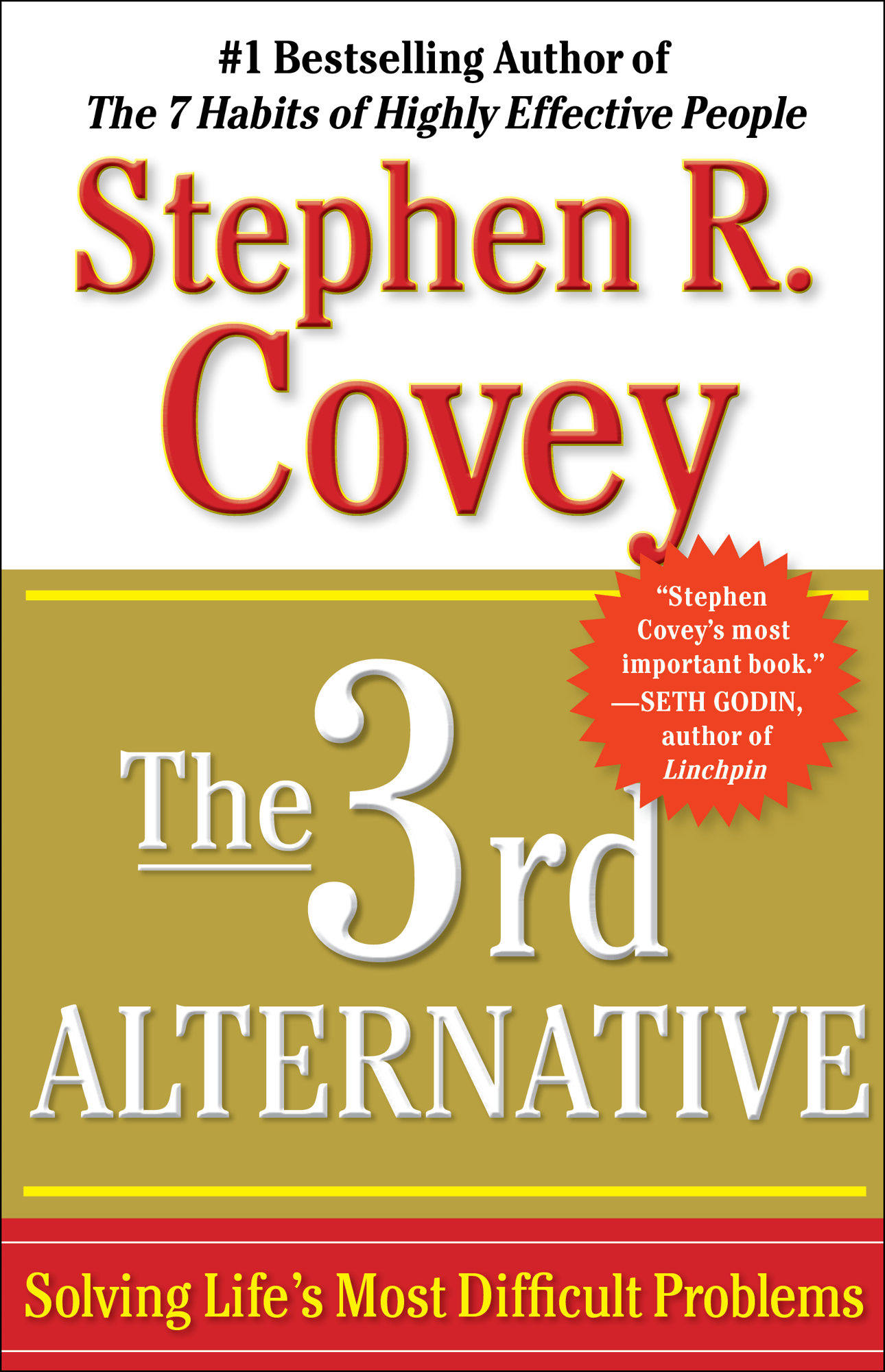
The 3rd Alternative
All cases come from Covey's consulting engagements with no controls or follow-up; the Israel-Palestine chapter contradicts the universality claim.
The four-step process and Criteria exercise are boardroom-ready. No guidance when the goodwill assumption breaks.
Naming binary framing as the disease is a real reorientation — Habit 6 stretched to 560 pages with no new mechanism.
Core Thesis
"Most conflicts are binary by convention, not necessity — synergizing rather than compromising reaches outcomes neither party imagined, through four paradigms and four steps that transform adversaries into co-creators."
Verdict
- Must read for: Executives and team leads managing persistent cross-functional conflict — budget disputes, product-vs.-engineering standoffs, labor-management negotiations — where compromise leaves both sides depleted and resentful
- Skip if: You’ve already absorbed Habit 6 from The 7 Habits of Highly Effective People deeply, or your conflict involves a party with no incentive to engage genuinely — the framework has nothing to say to bad-faith actors
- Core business value: Reframes negotiation from value-splitting (compromise) to value-creation (synergy) — the practical difference is deals both sides champion instead of tolerate
- The reviewer’s take: The central argument is sound and the four-step process is immediately usable, but this is an expansion of one chapter from 7 Habits stretched to 560 pages — the added case studies don’t deliver proportional insight, and the framework silently assumes goodwill exists, which is precisely what’s absent in the conflicts that matter most
Core Framework
The book’s central claim is that almost every conflict is framed as a binary: my way or your way. That framing is the disease. The 3rd Alternative is a methodology for escaping it — not by splitting the difference (compromise) but by generating a solution neither party had conceived before the process began. Synergy, in Covey’s framework, is not collaboration or compromise; it is a creative output that couldn’t exist without the friction between two perspectives.
The 4 Paradigms. Prerequisite mindsets that must hold before the four-step process begins. Without these, the process collapses immediately into advocacy.
- See Myself — Recognize your own position as a paradigm, not as reality. Your stance is a product of your history, incentives, and fears. Self-awareness is the entry condition.
- See You — Recognize the other party as a person with coherent internal logic, not as an obstacle. Their position makes sense to them for reasons worth understanding before you respond.
- Seek You Out — Actively engage the other party’s perspective before asserting your own. Ask questions before making statements. This is the behavioral manifestation of the first two paradigms.
- Synergize with You — Co-create rather than negotiate. “Yes, and…” replaces “Yes, but…” The output belongs to neither party’s original proposal.
The 4-Step Process. The operational sequence that follows once the paradigms are in place.
- Ask the 3rd Alternative Question — “Are you willing to go for a solution better than either of us has thought of?” This single question resets the conversation from adversarial to generative. Both parties must answer yes before any proposals go on the table.
- Define Criteria of Success — Before generating options, both parties name what a great solution would look like. This surfaces hidden shared criteria and makes explicit where real disagreement lives.
- Create 3rd Alternatives — Brainstorm without judgment. The rule is generativity: volume over quality, “yes, and” over evaluation. Options are not commitments.
- Arrive at Synergy — Identify which generated option satisfies all stated criteria. The solution is recognized, not negotiated — both parties feel it when they see it.
Case Discipline. The book’s most ambitious case is the Israeli-Palestinian conflict, which Covey presents as tractable via the 3rd Alternative. The case proves something different from what Covey claims: exactly this paradigm shift has been attempted by professional mediators for decades without stable resolution. When power asymmetry is structural and one party’s political legitimacy depends on continued conflict, the 3rd Alternative question has no lever to pull. The case exposes the framework’s scope boundary, not its power.
A more credible case: labor-management disputes in FranklinCovey consulting engagements, where the process was applied under its designed conditions — two parties with shared long-term stakes, roughly balanced power, and incentive to resolve. These cases support the framework. The leap to international conflict does not.
The 3rd Alternative is anecdote-driven throughout. Covey draws from personal consulting engagements and family stories, without sample sizes, controls, or longitudinal follow-up. Claims about universality (“every difficult problem has a third alternative”) outrun the evidence provided.
Tactical Framework
| Concept/Dysfunction | Organizational Symptom / Trigger | Leadership Intervention (The Play) |
|---|---|---|
| The 1-2 Binary Trap | Two departments locked in recurring standoff; meetings end in stalemate or forced compromise neither side implements fully | Open the next session with Covey’s exact question: “Are you willing to go for a solution better than either of us has thought of?” Require a yes before any proposals go on the table. Do not skip this step — it resets the conversational contract. |
| Criteria Mismatch | Agreement reached in the room falls apart in execution; both sides claim the other violated the deal | Run a Criteria of Success exercise before any solution generation: each party independently writes 3–5 bullet points describing what a great outcome looks like. Exchange lists. Overlapping criteria = shared ground. Diverging criteria = the actual conflict to solve. |
| Premature Evaluation | Brainstorms stall; every idea gets rejected before it develops; energy drops and parties revert to original positions | Enforce a 20-minute “no evaluation” brainstorm. Anyone who rejects an idea must first add to it (“yes, and…”). Appoint a facilitator whose only job is keeping evaluation off the floor. Capture everything on a shared visible surface — volume before quality. |
| Positional Identity Lock | One or both parties treat their position as identity; conceding feels like losing face; the conflict is about being right, not about outcomes | Separate the person from the position explicitly: “I understand this approach matters to you — help me understand what outcome you’re protecting.” Redirect from positions to interests. Name the underlying need, not the stated demand. |
Practical Tips
-
Run the Criteria Exercise on your next stuck decision: Before your next meeting where two parties have been gridlocked, ask each party to write independently: “What would a great solution look like? Name 5 criteria.” Share lists without comment. Count overlapping criteria — that’s your starting coalition. If the parties still disagree on every criterion after the exercise, you have a values conflict, not a resource conflict — it needs to be escalated differently.
-
Test the 3rd Alternative Question in a low-stakes conflict first: Choose a work dispute where the stakes are moderate — a process disagreement, a scheduling conflict. Ask: “Are you willing to go for a solution better than either of us has thought of?” Notice whether the question resets the room or gets dismissed. If the other party says no or deflects, you have learned something important: they are not in the process for a solution — reframe your strategy accordingly.
-
Map your own paradigm in writing before entering conflict: Write out, privately, the story you are telling about the other party in a current conflict. List your assumptions about their motives. Then write the most charitable possible version of why they hold their position — the version that makes them look reasonable. If you cannot write a charitable version, you are not ready for the 3rd Alternative process — you are in “See Myself” prerequisite work.
-
Audit your last three compromises: For each compromise your team reached in the last quarter, ask: did both parties champion the outcome afterward, or merely tolerate it? Tolerance is the leading indicator of future re-litigation. If two or more of three were merely tolerated, your team has a synergy deficit — the compromise pattern is costing you reopened conflict and implementation drag.
Critical Analysis
The 3rd Alternative captures something real — most conflicts are binary by convention, not necessity, and shifting from positional bargaining to co-creation produces better outcomes when conditions are right. The problem is the conditions clause. The framework is a philosophy for people of goodwill. It has no mechanism for bad-faith actors, power asymmetry, or zero-sum resource contests, and the book never acknowledges this scope limit.
STRONGER — Remote and async work environments. Async communication strips tone and body language, making positional entrenchment worse. A Slack thread cannot signal goodwill the way a room can. The “Seek You Out” paradigm — ask questions before asserting — is more valuable in writing-first organizations precisely because it is more effortful. Teams that institutionalize the criteria exercise before async proposal threads resolve conflicts faster than those that don’t.
WEAKER — Polarized organizational and political contexts. The book was written assuming parties who disagree share enough common ground to answer yes to the 3rd Alternative question. In organizations with entrenched factions, or in the political environments of 2024–2026, that assumption holds less. The book’s most ambitious chapter — applying the framework to the Israeli-Palestinian conflict — has aged poorly. The gap between aspiration and mechanism is largest exactly where Covey wants the framework to reach.
NEUTRAL — Standard corporate negotiation. Budget disputes, cross-functional standoffs, and vendor negotiations in 2026 look roughly as they did in 2011. The framework holds where both parties have shared long-term stakes and roughly equivalent power — exactly the conditions most internal corporate conflicts provide.
Two gaps the book doesn’t address: First, power asymmetry — when one party holds overwhelming leverage, the incentive to seek a 3rd Alternative evaporates. The framework assumes rough equality that doesn’t exist in most employer-employee or large company–small vendor relationships. Second, structural bad faith — some parties benefit from unresolved conflict: a plaintiff’s attorney on contingency, a negotiator whose career advancement requires a deal failure. Covey treats unwillingness as a mindset problem solvable by better paradigms. Sometimes it is a structural incentive problem solvable only by restructuring the relationship.
Roger Fisher and William Ury’s Getting to Yes (1981) is the book Covey should have engaged directly. It covers principled negotiation and BATNA — what to do when synergy fails — in operational depth Covey never reaches. By not engaging Fisher and Ury, The 3rd Alternative leaves readers without a fallback when the process stalls. The frameworks are complementary; the omission leaves the book feeling aspirational rather than complete.
Quotes
“Synergy is better than my way or your way. It's our way.”
“Synergy is what happens when one plus one equals ten or a hundred or even a thousand! It's the profound result when two or more respectful human beings determine to go beyond their preconceived ideas to meet a great challenge.”
“It's not only natural but essential for people to have different opinions. If two people have the same opinion, one of them is unnecessary.”
“We GET results based on what we DO, and what we DO depends on how we SEE the world around us.”