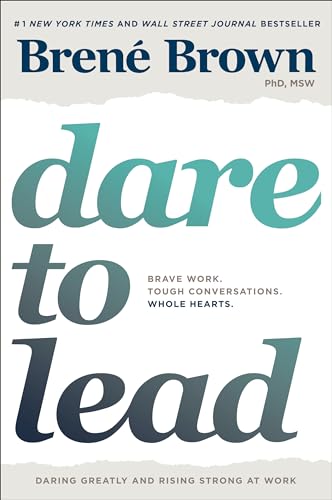
Dare to Lead
Grounded theory from 150 interviews is legitimate. No longitudinal data; no validation instrument for '100% measurable.'
Named tools — 'the story I'm making up,' BRAVING audit, permission slips — give managers scripts for the next one-on-one.
Armor as the upstream constraint is a useful reframe. Territory runs parallel to Radical Candor and Five Dysfunctions.
Core Thesis
"Courage is a teachable, observable, measurable skill set — and the single largest barrier to it inside organizations is not fear but the armor leaders wear to avoid being seen failing. Daring leadership replaces self-protection with rumbling, values-based decisions, trust built through specific behaviors, and a structured practice for getting back up after a fall."
Verdict
- Must read for/if: You manage people and keep hitting the same wall — feedback that doesn’t land, retros that go quiet, a team that talks around problems instead of through them. Also for senior leaders who have noticed that the politeness of their meetings is the price they’re paying for the candor of their decisions.
- Skip if: You’re hunting for org-design, strategy, or operational rigor. Brown is writing about the interior skill set of a leader, not the system around them. Also skip if you’ve already read Daring Greatly and Rising Strong recently — Dare to Lead is largely a workplace-applied recompilation, and the marginal new content is the BRAVING trust framework and the “armored vs. daring” behavior list.
- Core business value: A diagnostic and operating manual for the specific behaviors that make tough conversations actually move work forward — feedback, accountability, conflict, post-failure debriefs. Replaces the vague advice to “be more vulnerable” with named behaviors any manager can practice on Monday morning.
- The reviewer’s take: The framework holds. Brown identifies the right diagnosis — armor, not fear, is what stalls leadership behavior — and her named tools (BRAVING, the rumble, the story I’m making up, clear is kind, permission slips) are among the most operationally specific instruments any popular leadership book offers. The empirical foundation, though, is qualitative grounded theory built from 150 executive interviews and two decades of focus groups; the language of “research-based” oversells the methodology. Read it as a refined practitioner framework, not as social science.
Core Concepts
Daring leadership is one skill set built out of four sub-skills, all of which Brown claims are teachable, observable, and measurable: rumbling with vulnerability, living into your values, BRAVING trust, and learning to rise. The integrating insight is that the leader’s interior — the willingness to be seen failing — is the upstream constraint on every downstream leadership behavior, including feedback, conflict, accountability, innovation, and inclusion.
Rumbling with vulnerability is the foundation. A “rumble” is Brown’s name for a specific kind of conversation — one held with the explicit agreement that both parties will stay curious, name what they’re feeling, ask questions instead of defending positions, and remain in the discomfort long enough to surface what’s actually going on. The rumble has rituals: “the story I’m making up is…” surfaces interpretation as interpretation, separating fact from narrative; “what does support look like from you?” replaces assumed expectations with negotiated ones; “we’re clear that we’re not clear” makes ambiguity nameable instead of papered over. Rumbling is the operating layer for everything else in the framework.
Living into your values narrows abstract value statements into two named values and a list of observable behaviors that signal each. Brown’s claim is that values only function as decision filters if they are specific enough to predict behavior in advance. A leader who claims “integrity” as a value but cannot list four behaviors that demonstrate it and four that betray it is operating on aspiration, not on a value.
BRAVING trust decomposes trust into seven discrete components: Boundaries (clarity about what is and isn’t okay), Reliability (doing what you say, repeatedly), Accountability (owning, apologizing, repairing), Vault (confidentiality both ways), Integrity (choosing right over easy and practicing values rather than professing them), Non-judgment (asking for what you need without judgment, both ways), and Generosity (extending the most generous interpretation of others’ intentions). The point of the decomposition is operational: when trust is broken, you don’t say “trust is broken” — you say “you broke confidence on item three and we need to repair that specifically.”
Learning to rise is a three-step recovery loop for after a public failure: the reckoning (notice you’ve been emotionally hooked and walk through what happened), the rumble (interrogate the story you’re telling yourself about the failure), the revolution (revise the story based on what’s verifiable and integrate the new version into how you lead next). Brown’s claim is that leaders who can’t rise stop daring — the asymmetric cost of falling becomes prohibitive, and the result is risk-averse, armored leadership.
The frame that connects all four is armored vs. daring. Brown maps about a dozen common armor behaviors against their daring counterparts — being a knower vs. being a learner; tapping out of hard conversations vs. skilling up and leaning in; using shame and blame to manage others vs. using accountability and empathy; building a fitting-in culture vs. a belonging culture; leading from scarcity vs. modeling that we have enough. Each armored behavior is a self-protective move that succeeds at avoiding short-term discomfort and fails at producing the long-term outcomes the leader actually wants.
Evidence Quality: Brown grounds the book in two decades of qualitative research and 150 senior executive interviews conducted specifically for Dare to Lead, as documented on her own platform. The methodology is grounded theory — codes and categories emerge from coded interview transcripts — which is a legitimate qualitative research approach but is not the controlled-trial or large-sample social science the book’s marketing implies. The framework’s authority derives from internal coherence and practitioner resonance rather than from outcome data; no studies in the book track teams or leaders longitudinally to demonstrate that BRAVING-trained groups outperform controls. The thinnest claims are around measurability: Brown asserts the four skill sets are “100% teachable, observable, and measurable” but provides no measurement instrument or validation. Treat the framework as a high-quality practitioner taxonomy refined against many cases — not as an empirical model.
Practical Applications
| Concept/Dysfunction | Organizational Symptom / Trigger | Leadership Intervention (The Play) |
|---|---|---|
| Armored Knowing | Leader becomes defensive in disagreements; team stops bringing problems up because it isn’t worth the friction; meetings end with apparent agreement that doesn’t survive contact with execution | At the start of the next high-stakes meeting, say out loud: “I want to be a learner here, not a knower. If I move into defending instead of asking, name it.” Then track how many questions you ask before you state a position. Aim for three. |
| Unclear-Is-Unkind Feedback | Manager softens performance feedback to protect the relationship; the report leaves the meeting believing things are fine; the underlying issue surfaces months later as a termination or PIP | Apply “clear is kind.” Before the feedback conversation, write the single sentence you most need them to hear, unhedged. Open with that sentence verbatim. Then explain context, examples, and what good looks like. The vague version is the unkind one because it denies them the chance to course-correct. |
| Story-Interpretation Drift | Cross-functional friction; one team is convinced another is acting in bad faith; emails are over-explaining and CCing executives; trust has eroded without a specific incident | Introduce the “story I’m making up” protocol. In the next charged conversation, say: “Here’s what I observed. The story I’m making up about it is X. Can you tell me what I’m missing?” The script forces the speaker to name their interpretation as interpretation, opening room for the other party to correct rather than defend. |
| Trust Decomposition Gap | Team says “I don’t trust her” but can’t articulate why; performance reviews use “trust issues” as a label without a specific behavior trail; the same conflict recurs because the actual breach was never named | Run the BRAVING audit one-on-one. Walk through the seven elements (Boundaries, Reliability, Accountability, Vault, Integrity, Non-judgment, Generosity) and ask: which specific element feels broken, in which specific incident? Repair the named element. Generic “trust” is not actionable; “you committed to a deadline three times and missed it without flagging — Reliability is the issue” is. |
| Values-Behavior Disconnect | The company has values on the wall; the values do not predict any actual hiring, firing, or strategy decision; employees describe culture in terms unrelated to the stated values | Force values into behavior. Pick the team’s top two stated values. For each, list four behaviors that demonstrate it and four behaviors that betray it. Use the list as the criteria for the next hiring decision and the next performance conversation. If you cannot generate the eight behaviors, the value is not yet a value — it is an aspiration. |
| Post-Failure Avoidance | After a visible miss, the team buries the incident, runs a perfunctory retro, and accelerates into the next project; the same failure pattern repeats two quarters later | Run a structured rise: name the reckoning (what hooked you emotionally, what you did with that), the rumble (the story you told yourself about why it failed — overconfidence, missing data, someone else’s fault), the revolution (the revised story based on what’s verifiable, and one concrete behavior change for next time). Do this in writing. Reference it before the next analogous decision. |
| Permission-Slip Need | A team member knows what the right move is but won’t take it — a hard conversation, an unpopular opinion in a meeting, a request for help — because the cost of being seen as the person who does that feels too high | Use permission slips. Before the meeting, ask the person to write themselves a sentence: “I give myself permission to ___.” The act of naming the self-given permission converts a vague hope into a specific commitment they can hold themselves to during the meeting. Brown gives herself permission slips before her own keynotes; the play scales down to a 1:1. |
Practical Tips
-
Run a BRAVING audit on one relationship this week. Pick a specific working relationship where something feels off. Walk through the seven components (Boundaries, Reliability, Accountability, Vault, Integrity, Non-judgment, Generosity) and rate the relationship 1–5 on each. The diagnosis is the lowest one or two scores. Then have the conversation that names the specific component, not the generic “we have trust issues.” Notice how much faster the conversation gets to a repair when the breach is named precisely.
-
Deploy “the story I’m making up” in the next charged conversation. Pick a situation where you’ve been quietly resenting someone’s behavior. Open the conversation with: “Here’s what I noticed. The story I’m making up about it is ___. Tell me what I’m missing.” Two things will happen — you’ll discover your story was partly wrong, and the other person will be far less defensive because you named your interpretation as interpretation. The script does the work.
-
Translate one stated value into eight observable behaviors. Take a value your team claims to hold — integrity, ownership, customer obsession, whatever. List four behaviors that demonstrate it and four that betray it. The exercise is harder than it sounds, and the difficulty itself is the diagnosis: if the list won’t come, the value isn’t yet operational. Use the list at the next hiring debrief.
-
Rewrite one piece of feedback to be unhedged. Pick the most recent piece of feedback you gave that the recipient probably misread as smaller than you meant. Rewrite it in one sentence, unhedged, as you wish you had said it. Notice the gap between the version that landed and the version that would have. Clarity is the kindness.
-
Write yourself a permission slip before a meeting you’ve been dreading. On an index card or a sticky: “I give myself permission to ___.” Disagree publicly with the senior person. Say I don’t know. Ask for help. Whatever you’ve been quietly avoiding. Carry the card into the room. Notice whether naming the permission makes you more likely to use it.
Critical Analysis
The central argument — that armor, not fear, is the constraint on courageous leadership, and that the skill set for daring leadership is nameable and learnable — holds, and the operational tools Brown gives are among the most practitioner-ready in the genre; the framework’s weakness is not the diagnosis but the evidence base, which is qualitative grounded theory dressed in the rhetoric of measurable social science.
Modern Conditions:
-
Remote and hybrid teams — STRONGER. Vulnerability behaviors that felt risky in person are slightly de-risked over video and async; people will write a “the story I’m making up about this is…” in a Slack thread that they might not say out loud in a conference room. At the same time, the absence of incidental contact means trust has to be built through explicit behaviors rather than ambient ones — which is exactly what BRAVING decomposes. The framework was written for in-person workplaces but maps onto distributed work better than most leadership models from the same era.
-
AI tools and the rise of “knower” culture — WEAKER. Brown’s “knower vs. learner” axis assumes the knower’s confidence comes from internal expertise. With LLM access, every meeting participant can sound informed in seconds, and the temptation to perform expertise has compounded. Her advice to “stay curious” lands the same; the friction against it has gone up. The framework needs an update for environments where confident-sounding answers are cheap.
-
Public callout dynamics and reputation risk — WEAKER. Dare to Lead assumes that the cost of vulnerability is mostly interpersonal — looking foolish in front of a colleague. The cost has risen: a clip, a screenshot, an anonymous post can scale a moment of vulnerability into a permanent record. Brown’s framework doesn’t address how to practice rumbling in a context where the rumble might be filmed. Leaders are correctly more cautious than her framework implies they should be.
Framework Gaps:
- No treatment of structural power asymmetry. Brown writes as if rumbling is mutually available, but in most workplaces it isn’t — the cost of vulnerability for the senior person and the junior person are categorically different. A leader who says “the story I’m making up is you don’t respect me” and a report who says the same sentence are operating with completely different risk profiles. The framework needs a power-aware version of itself, and the book doesn’t provide one.
- Underweights the role of organizational design. Brown locates the constraint on courageous behavior almost entirely in the individual leader’s interior skill set. But teams with the same leader behave very differently inside permissive vs. punitive systems. The book reads as if armor is a personal choice; for many leaders, it is a rational response to the organization they work in. Patrick Lencioni’s Five Dysfunctions sits in roughly the same territory and integrates structure better.
Competing Frameworks:
- Kim Scott’s Radical Candor covers similar territory — direct feedback as care — with a sharper 2x2 (care personally / challenge directly) and a more deployable script library. Brown’s “clear is kind” is essentially Scott’s “ruinous empathy” failure mode named from the inside; the omission matters because Scott’s framework gives you a four-quadrant diagnostic Brown’s continuum doesn’t.
- Patrick Lencioni’s Five Dysfunctions of a Team addresses the same trust-vulnerability nexus and locates the dysfunction structurally rather than individually. By not engaging Lencioni, Brown leaves unaddressed the question of how to install daring leadership in a team where the leader is daring but the team mechanics are still rewarding armor.
- Amy Edmondson’s The Fearless Organization is the empirical complement Brown’s book needs. Edmondson’s psychological safety research provides the controlled-study evidence base that Brown’s grounded-theory work asserts but doesn’t supply. Reading them together gives you both the qualitative texture (Brown) and the quantitative validation (Edmondson) of the same underlying claim.
Quotes
“Clear is kind. Unclear is unkind.”
“I define a leader as anyone who takes responsibility for finding the potential in people and processes, and who has the courage to develop that potential.”
“The courage to be vulnerable is not about winning or losing, it's about the courage to show up when you can't predict or control the outcome.”
“Daring leaders work to make sure people can be themselves and feel a sense of belonging.”