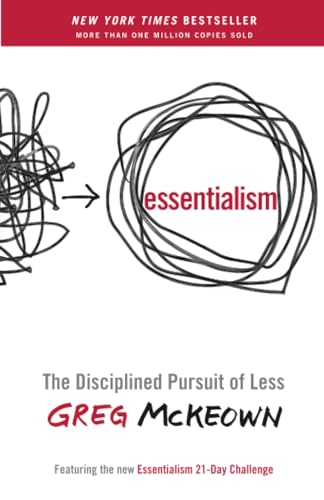
Essentialism
Buffett's "25 goals" story is apocryphal — he's denied it. Jobs's cull proves elimination is necessary, not sufficient.
90 Percent Rule and clear-yes test are operable filters. The book offers no protocol for commitments the reader cannot decline.
Saying no as discipline is a useful reframe. Drucker made the same argument earlier with sharper mechanics.
Core Thesis
"High performers stall not from lack of effort but from undisciplined yes-saying; the remedy is a deliberate filter — 'if it isn't a clear yes, it's a clear no' — applied to every commitment, project, and meeting."
Verdict
- Must read for/if: Mid-career operators and founder-leaders whose calendars have filled up faster than their judgment about what to put on them — people producing acceptable output across too many fronts who suspect they are mediocre everywhere instead of excellent somewhere.
- Skip if: You have already internalized Drucker’s The Effective Executive or Cal Newport’s Deep Work; the conceptual core is identical and McKeown adds polish rather than new mechanism. Skip also if your constraint is execution under low autonomy — the book assumes you control your own calendar.
- Core business value: A defensible “no” protocol for leaders. The argument converts saying no from a social risk into an operating discipline, which compounds into focus capital — the rarest resource in a senior role.
- The reviewer’s take: The central claim holds — most senior performance loss comes from yes-inflation, not effort deficit — but the book sells a privileged version of the cure. McKeown writes for the executive who can decline a meeting; he does not address the operator whose calendar is set by someone above them. Read it for the filter, ignore the lifestyle photography around it.
Core Concepts
McKeown’s term for the discipline is Essentialism — the deliberate practice of distinguishing the vital few (commitments that produce disproportionate return) from the trivial many (commitments that feel productive but yield ordinary output). The pivot is not time management; it is choice architecture applied to one’s own life.
The mechanics run in three phases. Explore — widen the set of options under consideration before committing to any, because the cost of a fast yes is exposure to opportunities you will never see. Eliminate — apply a high-bar filter to every option and cut anything that does not clear it. Execute — design the environment, schedule, and routines so the few surviving commitments run on rails rather than willpower.
Two filters do most of the work. The 90 Percent Rule instructs you to score each opportunity 0–100 on its single most important criterion; anything below 90 is a no. The reasoning: opportunities in the 60–80 band feel acceptable but block your availability for the 95s that arrive later. The clear-yes test — “if it isn’t a clear yes, then it’s a clear no” — is the heuristic version for situations where you can’t formally score. Both share one mechanism: they raise the threshold for commitment so the default state is non-commitment, reversing the cultural default. Supporting mechanisms include trade-off recognition (every yes is a no to something else, so make the trade visible before deciding), buffer creation (build slack into estimates so unforeseen costs don’t cascade), and sleep as performance infrastructure (treat seven-plus hours as a non-negotiable input to judgment quality).
Cases (and what they actually prove):
McKeown leans on a small recurring cast. Three carry most of the weight:
- Steve Jobs returning to Apple in 1997. McKeown uses the radical product-line cut — Jobs killed roughly 70% of Apple’s products on returning — as evidence that essentialist elimination produces breakthrough output. What the case actually proves vs. what McKeown claims: it proves that a returning founder with absolute authority, a starving balance sheet, a complicit board, and a once-in-a-generation product instinct can cut deeply and survive. It does not prove that “eliminate the non-essential” is the operative variable. Jobs’s cut worked because the survivors (iMac, then iPod, then iPhone) were generationally good products. A manager who cuts 70% of their portfolio without a generational product underneath gets a smaller, focused company that still loses. The case is being used to argue that elimination causes outsize success; it actually shows elimination is necessary but radically insufficient.
- Warren Buffett’s “twenty-five goals” filter. McKeown cites the story (you list 25 goals, circle 5, and the other 20 become your “avoid-at-all-costs” list) as Buffett’s essentialism in practice. What the case actually proves vs. what McKeown claims: Buffett has publicly denied originating the exercise, calling it apocryphal. Even taken on its own terms, the parable proves only that a thought experiment about ranking can produce clarity — not that Buffett’s investment returns derive from such a filter. Buffett’s actual edge is closer to “permanent capital plus circle of competence plus long holding periods,” none of which are essentialist tactics. The case is doing rhetorical work the underlying story can’t bear.
- Peter Drucker’s concentration principle. McKeown invokes Drucker as patron saint, citing the executive’s job to “concentrate on the one task at hand.” What the case actually proves vs. what McKeown claims: Drucker’s actual argument in The Effective Executive (1967) is denser and includes systematic time-logging, strength-based assignment, and contribution analysis. McKeown borrows the conclusion without the mechanism. The citation proves that essentialism has a respectable lineage; it does not prove that McKeown’s lighter version of the discipline produces Drucker’s results.
Evidence Quality: Essentialism is anecdote-driven. McKeown reuses the same cast across chapters — Drucker’s “twenty percent of effort produces eighty percent of results,” Buffett’s “twenty-five goals” filter (likely apocryphal — Buffett has publicly denied it), Steve Jobs’s product cull at Apple. Each case is presented as confirming the discipline; none is presented with the question “what else was true about this person that produced the outcome?” The frame holds for senior individuals with calendar autonomy; it has not been tested against entry-level workers, parents of young children, or workers in pinned-down operational roles. The discipline is real; the universal claim is not earned by the evidence in the book.
Practical Applications
| Concept/Dysfunction | Organizational Symptom / Trigger | Leadership Intervention (The Play) |
|---|---|---|
| Undiscerning Yes (the trivial many) | Calendar booked 80%+ in advance; senior staff in 6+ meetings/day; every project rated “important”; team can’t articulate the top three priorities the same way | Apply the 90 Percent Rule to inbound requests this week. For each, name the single dominant criterion (revenue impact, strategic fit, learning value). Score 0–100. Anything <90 declined with: “This is a no for me right now — I’m protecting capacity for [the stated top priority].” Track decline count weekly. |
| Optionality Hoarding | Multiple half-built initiatives; sunk-cost arguments dominate roadmap reviews; nothing shipped to GA in past quarter despite full team | Run a sunk-cost reset: list every active initiative, ask “If I weren’t already invested in this, would I start it today?” Anything that fails the test gets killed within 14 days. Reassign capacity to the survivors. Communicate the kills publicly so the team learns the new threshold. |
| Buffer Collapse | Estimates routinely miss by 30%+; team in firefighting mode after every release; small surprises cause cascading slips | Add 50% buffer to every estimate longer than one week. Schedule no meetings in the 30 minutes after deep-work blocks. Hold a standing “no-meeting” half-day weekly. Measure recovery time after the next unplanned incident; expect it to drop. |
| Reactive Prioritization | Whoever escalates loudest gets the next sprint slot; leadership’s stated top-3 doesn’t match where engineering hours actually go | Publish a written essential intent — one sentence per quarter naming what you are uniquely positioned to do — and post it where every standup can see it. Require any new request to be argued against this intent before it enters the backlog. Silent veto doesn’t count; the trade-off must be named. |
| Sleep Debt as Hidden Tax | Senior leaders running on 5–6 hours; late-night Slack norms; decision quality visibly degrading by Thursday afternoon | Set a personal hard stop on work communications at a fixed hour; broadcast it. Model leaving meetings that run into protected sleep windows. Track the next 10 high-stakes decisions made on <6 hours vs. ≥7; expect a visible quality delta. |
Practical Tips
- Run a 90 Percent Rule audit on your recurring meetings. Take every recurring meeting on your calendar. For each, score it 0–100 on one criterion you choose in advance (e.g., “directly advances quarterly objective”). Cancel or decline everything below 90 by Friday. If 30 days later your shipped output hasn’t moved and no canceled meeting has been reinstated by stakeholders, you’ve learned the meetings were pure overhead — and that your team will not defend low-value rituals once you stop convening them.
- Write your essential intent in one concrete sentence. Force yourself to complete: “If we are succeeding twelve months from now, the one thing that will be true is ___.” Refuse abstractions like “be the best in our market.” If after one week of trying you still cannot finish the sentence in a way that names a measurable outcome and a specific population, you’ve learned you don’t have a strategy — you have a brand statement, and the next move is strategy work, not execution discipline.
- Kill one half-built project on Friday. Pick the initiative you’ve been carrying out of inertia. Announce the kill publicly and reassign the capacity to the highest-clarity surviving project. If 30 days later no customer, no team member, and no executive has asked about the killed work, you’ve learned it was being sustained by your guilt about sunk cost, not by demand — and the same is likely true of two or three other initiatives on your list.
- Add a 24-hour buffer to your next yes. When the next non-urgent request arrives, respond: “Let me get back to you tomorrow.” Use the gap to ask whether you’d accept this if your calendar were empty. If after two weeks of running this protocol your acceptance rate has not dropped by at least a third, you’ve learned your problem isn’t impulsive yes-saying — it’s that the requests reaching you are already pre-filtered, and the leverage point is upstream (who has access to your calendar), not in your reply latency.
- Protect one sleep window for a week. Set a non-negotiable lights-out hour for seven consecutive nights. Each morning, rate your decision quality 1–5 before checking messages. If at the end of the week the difference between your highest-sleep and lowest-sleep days is less than half a point on the 5-point scale, you’ve learned your judgment problems are not primarily a sleep problem — look upstream at caffeine timing, calendar density, or decision volume per day.
Critical Analysis
The argument that high performers fail through undisciplined yes-saying rather than effort deficit is correct, and the filters McKeown offers are useful enough to justify the read; the framework breaks when applied to anyone without meaningful calendar autonomy, and McKeown never confronts that limitation honestly.
Modern conditions:
- Async, distributed work — STRONGER. Remote work multiplies inbound surface area: every channel, every timezone, every “quick sync” request. The 90 Percent Rule is more useful in 2026 than in 2014 because the volume of trivial-many inputs has risen faster than calendars can absorb. Knowledge workers now report meeting load roughly 50% above pre-2020 levels; the filter is one of the few defenses that scales.
- AI-amplified output — STRONGER. When an individual contributor’s throughput on routine tasks rises 3–5x via generative tools, the binding constraint moves from execution capacity to judgment about what to build. McKeown’s framework is judgment training. The leaders who win the AI transition will be the ones who can tell the team what not to ship, not the ones who ship most.
- Caregiving and dual-income households — WEAKER. The book’s implicit reader is the executive whose home life is supported by infrastructure (a partner managing logistics, a private school, paid help). For a parent of small children or someone in a caregiving role, “eliminate the non-essential” runs into the fact that the non-essentials are other people’s needs. McKeown gives no protocol for negotiating that, and the silence reads, in 2026, as a class-coded omission.
Gaps:
- No mechanism for involuntary commitments. The framework treats every yes as voluntary. Most operators below the C-suite have a meaningful share of their week assigned by someone else. McKeown offers no script for filtering inputs you cannot decline, only for declining inputs you could anyway.
- Single-actor model. The book optimizes one individual’s calendar; it does not address what happens when a team is collectively un-essentialist — when your “vital few” requires three colleagues’ “trivial many” cooperation. The systems version of the argument is missing.
Competing frameworks the author should have engaged:
- Peter Drucker, The Effective Executive (1967) — Drucker laid out the same core argument fifty years earlier with sharper organizational mechanics (concentration, time logging, strength-based assignment). McKeown cites Drucker as inspiration but never reckons with the question of what Essentialism adds beyond style; ignoring this leaves the reader unsure whether to read both or just the older, denser book. The answer, honestly, is read Drucker.
- Cal Newport, Deep Work (2016) — Published two years after Essentialism, but the comparison still holds: Newport gives a mechanism (cognitive concentration produces non-linear output) where McKeown gives a heuristic (less but better). Newport’s frame explains why the filter works; McKeown’s frame stops at the filter itself. Reading McKeown without Newport leaves the discipline floating without theory.
- David Allen, Getting Things Done (2001) — Allen offers the opposite default: capture everything, then triage. McKeown rejects this implicitly by raising the capture threshold. The omitted question is whether high-volume creative roles (writers, researchers, founders in idea-generation phase) actually do better with Allen’s net than with McKeown’s filter. The book never acknowledges that the right default depends on the role.
Note: This is Phase 1 (research-based executive briefing). The /enrich-book skill will validate all claims against the PDF and deepen critical analysis if needed.
Quotes
“Essentialism is not about how to get more things done; it's about how to get the right things done.”
“If it isn't a clear yes, then it's a clear no.”
“Remember that if you don't prioritize your life someone else will.”
“You cannot overestimate the unimportance of practically everything.”