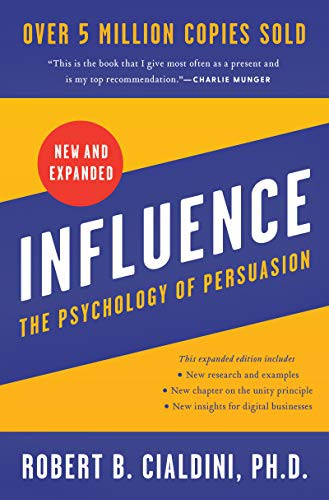
Influence: The Psychology of Persuasion
Studies replicate cross-culturally. Three undercover years in compliance professions adds ecological validity.
Each principle maps to a situation and mechanism — micro-commitment close, reciprocity audit, scarcity signal.
Framing compliance as automatic trigger-based patterns — not logic — shifts where practitioners look for leverage.
Core Thesis
"Human compliance follows seven universal psychological principles that function as automatic triggers — and those who understand these triggers can deploy them to get more yeses, while those who don't will be systematically exploited by those who do."
Verdict
- Must read for/if: You sell, negotiate, fundraise, manage, market, or lead — in any context where getting people to say yes matters. Also essential for anyone who wants to recognize when these techniques are being used on them. The business case is direct: these principles are already being deployed against you by every sophisticated sales and marketing organization you interact with.
- Skip if: You want a theoretical framework for understanding persuasion at the cognitive architecture level. Cialdini gives you the what and when but not the deep why — read Kahneman’s Thinking, Fast and Slow for the underlying mechanism. If you’re primarily interested in policy-level applications, Thaler and Sunstein’s Nudge applies these same principles to institutional design.
- Core business value: A complete taxonomy of the psychological levers that move human decisions. Learn it once; recognize it everywhere. The principles show up in every sales deck, every pricing page, every fundraising email, every negotiation room — understanding them is table stakes for anyone in a professional context where persuasion matters.
- The reviewer’s take: The original six principles hold up across four decades of subsequent research — this is the rare business book that got the science right and the application right simultaneously; the 7th principle (Unity, added in 2021) is the weakest of the set, resting on considerably thinner experimental ground than the original six.
Core Concepts
Cialdini’s central argument is that human compliance is not random. It follows predictable, automatic patterns — what he calls “weapons of influence” — that evolved as efficient cognitive shortcuts but make us exploitable by anyone who knows the trigger points. The principles don’t require the target to be gullible or inattentive; they work precisely because they are evolutionarily calibrated to feel right.
Reciprocity is the obligation to repay what others give us. The rule is asymmetric and automatic: even small, uninvited gifts create indebtedness, and the compliance they generate is often disproportionate to the gift’s value. In Joe Regan’s classic experiment, subjects who received an unsolicited Coke from a researcher bought twice as many raffle tickets from him later — regardless of how much they actually liked Regan. The obligation ran independent of the relationship. The implication: giving first, even something trivial, dramatically shifts the compliance equation.
Commitment and Consistency exploits our drive to behave in ways that align with past positions. Small initial commitments escalate: homeowners who accepted a small “Drive Safely” window sticker were four times more likely to later accept an ugly lawn billboard on the same theme. Written commitments amplify the effect further — they’re public, effortful, and felt as self-defining. The foot-in-the-door technique is this principle operationalized: get a small yes, then escalate. The key mechanism isn’t agreement — it’s the internal pressure to remain consistent with a prior self-statement.
Social Proof is the heuristic of following what similar others are doing when uncertain about correct behavior. The principle operates most powerfully in ambiguity and in crowds. The bystander effect — where emergency victims receive less help when more people are present — is social proof in reverse: nobody acts because everyone reads everyone else’s inaction as evidence that acting isn’t warranted. Practically, social proof explains why testimonials, ratings, “bestseller” labels, and “most popular” tags convert at rates that pure product quality doesn’t predict.
Authority is the tendency to defer to experts and symbols of expertise — titles, uniforms, trappings — even when the expertise is unverified. Milgram’s obedience experiments are authority’s most disturbing demonstration: ordinary people administered what they believed were painful electric shocks to strangers when an authority figure in a lab coat instructed them to. For practitioners, the implication runs both ways: legitimate credentials increase compliance, but so do fabricated ones — the mechanism doesn’t check validity.
Liking is the simple fact that we comply more readily with people we like. Three factors drive it: physical attractiveness (whose halo effect extends compliance to unrelated domains), perceived similarity (shared backgrounds, attitudes, interests — real or constructed), and familiarity (mere exposure increases liking over time). Compliance professionals engineer all three: they find common ground, mirror values, and invest time before the ask. Studies of physical attractiveness in courtrooms show measurably lighter sentences for attractive defendants — a systematic bias, not an anecdote.
Scarcity makes things more desirable when their availability is limited or declining. Two mechanisms: we want what we can’t have (psychological reactance), and we use scarcity as a proxy for quality. The effect is strongest when scarcity arises from social competition — the item is scarce because others want it too, which compounds both mechanisms simultaneously.
Unity (added in the 2021 edition) is the principle of shared identity. We comply more with those we experience as members of our group — family, tribe, political affiliation, nationality, religion. Cialdini distinguishes Unity from Liking: Liking is about how you feel about someone; Unity is about shared being. Co-creation (building something together) and shared hardship are the most powerful Unity-builders, because they create genuine identity overlap rather than manufactured similarity.
Evidence Quality: The original six principles are backed by decades of peer-reviewed social psychology research from multiple independent labs. The foundational studies — Regan’s Coke experiment, Milgram’s obedience work, the drive-safe billboard study, Festinger’s cognitive dissonance research — have been replicated across contexts and cultures. Cialdini’s three-year undercover fieldwork in compliance professions adds ecological validity that purely laboratory-based frameworks lack. The 7th principle (Unity) has considerably thinner experimental support — Cialdini acknowledges it, but the evidence base lags the other six by roughly three decades of research density.
Practical Applications
| Concept/Dysfunction | Organizational Symptom / Trigger | Leadership Intervention (The Play) |
|---|---|---|
| Reciprocity Under-Used | Sales team leads with pitch; prospects feel no prior obligation; conversion rates are low despite strong product | Give first, unconditionally: send a genuinely useful resource, data point, or connection before any ask. Make it specific to their problem, not generic. The gift must feel personal — a forwarded newsletter doesn’t create obligation the way a tailored insight does. |
| Commitment Escalation Ignored | Deals die after initial enthusiasm; prospects agree in principle but don’t follow through; proposals go dark | Get micro-commitments on record early: “Can we agree that X is the core problem?” followed by “Can I send a short summary of what we discussed?” Written summaries are especially powerful — they activate consistency pressure. Never leave a call without a documented next step the prospect articulates themselves. |
| Social Proof Gap | Product quality is strong but sales velocity is slow; prospects ask “who else is doing this?” and don’t get a satisfying answer | Audit and display social proof at the decision moment: specific named customers (with permission), use-case testimonials, quantified outcomes. “500 companies use us” is weaker than “Acme reduced onboarding time by 40%.” Similarity matters — a prospect in healthcare wants healthcare examples, not general ones. |
| Authority Signals Missing | Qualified team, strong results, but perceived as a vendor rather than an expert; prospects negotiate on price rather than value | Signal authority before the meeting: send relevant research, reference a published framework, establish domain expertise in the pre-call touchpoint. In the call, cite external validation (studies, third-party data) rather than only self-referential claims. Authority borrowed from respected sources transfers. |
| Scarcity Fabricated or Absent | Either no urgency (deals drift into “next quarter”) or manufactured scarcity that prospects see through and distrust | Create legitimate scarcity from real constraints: implementation capacity, cohort size, pricing windows tied to actual cost changes. State the reason explicitly — “We’re onboarding three new clients in Q2 and can take one more” is credible; “This offer expires Friday” with no explanation is not. Scarcity without reason triggers suspicion, not urgency. |
| Unity Not Established | Enterprise deals stall at the champion level; champion can’t get internal buy-in; the buying team doesn’t feel ownership | Co-create the proposal with the champion: have them draft the success criteria, have them name the problem in their own language. When people help build the solution, they advocate for it internally as their own work. Ask questions that invite their expertise into the process — Unity through co-construction. |
Practical Tips
-
Run a reciprocity audit on your outreach. Look at your last ten cold outreach messages. Count how many led with value (useful content, a relevant insight, a warm introduction) versus how many opened with a request. Anything below 5:1 value-to-ask is a reciprocity deficit. Rewrite one sequence to give first across three touches before asking anything.
-
Document the micro-commitment in every call. At the end of your next five sales or leadership conversations, close by asking the other person to state the agreed next step aloud — then send a two-sentence written summary. Notice whether follow-through rates change. The act of writing creates consistency pressure that verbal agreements don’t.
-
Identify the scarcity signal in your last three lost deals. Ask: did the prospect have a clear reason to decide now? If not, find one legitimate constraint (capacity, cohort timing, pricing structure) and practice stating it with its reason. Test whether explicit, reasoned scarcity changes conversation pace.
-
Map your social proof to prospect similarity. Pull your three strongest testimonials. Now ask: do they describe outcomes in the same industry, role, and problem context as your current top prospects? If not, identify the gap and ask one satisfied customer in the right category for a specific outcome-based quote.
-
Practice the authority transfer. Before your next important meeting, send one piece of external research — a study, a data point, a third-party analysis — that’s relevant to the prospect’s problem. Don’t cite yourself; cite the research. Notice whether the framing of the conversation changes when you arrive as someone who’s read the literature rather than someone who’s selling.
Critical Analysis
Influence is the rare business book that earned its canonical status — the six original principles are empirically grounded, practically deployed across every domain of professional life, and as relevant in 2026 as they were in 1984. The framework’s weakness is not in what it got wrong but in what it doesn’t cover: it tells you which triggers exist but not how to diagnose which trigger to pull, for which person, in which moment.
Modern Conditions:
-
Digital-scale deployment — STRONGER. Social media algorithms amplify social proof and scarcity industrially. “X people are viewing this item” and five-star review counts are Cialdini’s principles running at machine speed. Dark-pattern UI design is applied Cialdini: countdown timers (scarcity), pre-checked boxes (commitment), “verified purchase” badges (authority), “customers like you also bought” (social proof and similarity). The principles haven’t weakened — they’ve been automated.
-
AI-personalized persuasion — STRONGER. LLM-powered sales and marketing tools can now simultaneously tailor all six principles to an individual target in real time — finding common ground (liking/Unity), establishing domain credentials (authority), surfacing relevant testimonials (social proof), and constructing scarcity from available data. The scale of professional manipulation available to anyone with an API key has increased by orders of magnitude since 1984.
-
Informed audience / habituation effect — WEAKER. Cialdini’s principles are now widely taught in business schools, sales training programs, and growth marketing courses. Sophisticated buyers have pattern-matched the tactics and become resistant to crude deployments. Manufactured scarcity (“Only 3 left!”) triggers suspicion in anyone who’s seen it a hundred times. The defense instructions in the book — recognize the tactic, pause, reassess — are more available than they’ve ever been. The principles still work; they require more skill to deploy well.
Framework Gaps:
-
The most significant structural gap is the absence of a diagnostic layer. The book tells you that social proof works in conditions of uncertainty and similarity — but it doesn’t tell you how to assess whether your specific target is in a state of uncertainty, whether they identify with the social group you’re invoking, or when reciprocity will backfire by feeling transactional. Practitioners are left to develop this intuition themselves. Cialdini’s Pre-Suasion (2016) begins to address this — the idea that directing attention before the ask shapes receptivity — but the gap in the original work remains.
-
The defense instructions are structurally mismatched to the attack. The principles operate on System 1 (automatic, fast, unconscious), but Cialdini’s defenses require System 2 (deliberate, slow, effortful): “stop and ask yourself whether you’re being manipulated.” Asking someone to engage effortful thinking at the moment they’re being triggered by an automatic response is exactly the wrong cognitive architecture. Thaler and Sunstein’s choice architecture approach handles this better — the defense is built into the environment, not into the target’s moment-by-moment vigilance.
Competing Frameworks:
-
Daniel Kahneman’s Thinking, Fast and Slow (2011) provides the cognitive architecture Cialdini doesn’t supply. System 1/System 2 explains WHY the automatic triggers work at a neurological level — the principles fire because they route around deliberate evaluation. By ignoring this architecture, Cialdini leaves practitioners without a model for when conscious persuasion attempts will be routed to System 2 and scrutinized. The two books are not alternatives — you need both.
-
Richard Thaler and Cass Sunstein’s Nudge (2008) applies the same principles to institutional choice architecture rather than individual persuader tactics. Their concept of defaults as commitment/consistency triggers, and of making the desired behavior the path of least resistance, extends Cialdini into policy and organizational design in ways the original book doesn’t reach. By not addressing how these principles can be designed into systems rather than deployed by individuals, Cialdini undersells the full scope of his own framework.
Quotes
“The rule says we should try to repay, in kind, what another person has provided us.”
“We will use the actions of others to decide on proper behavior for ourselves, especially when we view those others as similar to ourselves.”
“People seem to be more motivated by the thought of losing something than by the thought of gaining something of equal value.”
“A well-known principle of human behavior says that when we ask someone to do us a favor we will be more successful if we provide a reason.”