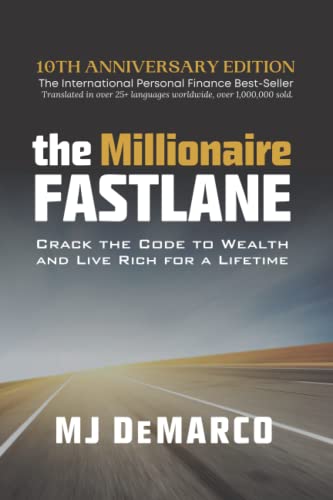
The Millionaire Fastlane
The evidence rests on DeMarco's Limos.com exit and forum anecdotes only — no peer-reviewed research, no cohort data.
CENTS screen, pre-sale test, revenue-time-coupling give specific filters — book stops at vehicle selection.
The CENTS framework and Net Profit × Asset Value equation are a sharper lens than any standard personal-finance frame.
Core Thesis
"Wealth in a working lifetime requires a business that produces income decoupled from your time and scaled across many buyers — the standard save-and-invest path mathematically cannot get most people there, and any vehicle that fails the five CENTS tests (Control, Entry, Need, Time, Scale) is a job in disguise."
Verdict
- Must read for/if: Founders, would-be founders, and operators stuck in high-income jobs who suspect their wealth plan is structurally broken but cannot name why. Especially useful for anyone evaluating a side business, franchise, real estate play, or content/SaaS idea and trying to decide whether it is a real wealth vehicle or a self-employed job with extra steps.
- Skip if: You want academic rigor, balanced citation of sources, or a measured tone. Skip also if you are already running a CENTS-positive business and need operating tactics — DeMarco is strong on vehicle selection, weak on what to do once you are inside one. Skip if a polemical voice will distract you from the actual ideas.
- Core business value: Replaces the standard personal-finance frame (“income × savings rate × time × market return”) with a structural test for whether a wealth vehicle can produce real money in a real working life. The CENTS checklist converts a vague ambition (“I want to start a business”) into a five-axis screen that kills most ideas before they consume years of effort.
- The reviewer’s take: The CENTS framework is the sharpest single tool in popular entrepreneurship writing for distinguishing scalable businesses from glorified self-employment, and the “decouple income from time” insight is genuinely load-bearing — but the book wraps that insight in survivorship bias, contempt for index investing that the math does not support, and a polemical voice that obscures how narrow its target reader actually is.
Core Concepts
DeMarco classifies every financial life into one of three roads. The Sidewalk is debt-funded consumption with no asset base: income comes in, gets spent, and the person remains one paycheck from disaster regardless of how much they earn. The Slowlane is the standard personal-finance prescription: a stable W-2 job, 10–15% savings into index funds, 40 years of compounding, and retirement at 65. The Fastlane is ownership of a scalable business that produces income decoupled from hours worked and can be sold as an asset.
The book’s central claim against the Slowlane is mathematical, not motivational. The Slowlane assumes (1) you keep your job for 40 years, (2) markets return 7% real, (3) you save consistently, and (4) you live long enough to spend the money. DeMarco’s argument is that the dependency chain is fragile (any single link breaks the plan) and that the timing is wrong (most of the wealth lands when you are too old to consume it). His objection is structural, not motivational — he is not saying index funds are bad assets, he is saying that wealth-by-compounding has a 40-year time horizon that compounds against your remaining life expectancy.
The Fastlane vehicle is filtered by the CENTS acronym — a five-axis test every business idea must pass:
- Control — you own the business; the rules, customers, and pricing are yours. Affiliate marketers, Amazon FBA sellers, and Uber drivers fail Control because the platform can deplatform them, change terms, or absorb their margin overnight. Whoever owns the rules owns the business.
- Entry — high barriers to entry protect margin. Low-barrier businesses (“dropship anything,” “open a coffee shop,” “become a YouTuber”) attract amateur competition that competes margins to zero. DeMarco wants difficulty to be your moat.
- Need — the business solves a real, monetizable problem for an identified buyer. Passion projects without identified buyers fail Need. The test is whether someone will pay before you build.
- Time — income detached from hours. If you stop working, does revenue stop tomorrow? A consultancy fails Time because revenue tracks hours. A SaaS, a book, a real estate portfolio, or a productized service with operators in place passes Time because the asset earns while you sleep.
- Scale — the business can serve thousands or millions, not dozens. A regional dental practice has a scale ceiling; a software product, a media property, or a manufactured good does not. Scale is what converts a comfortable income into seven-figure wealth.
The reframed wealth equation that follows from CENTS is Net Profit × Asset Value. A Slowlane saver compounds savings; a Fastlane operator compounds profit AND builds a sellable asset valued at a multiple of that profit. The same dollar of earnings produces an order of magnitude more terminal wealth in the Fastlane because the asset multiple stacks on top of the annual cash flow. This is the framework’s sharpest move — it makes visible the gap between income and equity that the standard personal-finance literature glosses over.
Evidence Quality: Thin and openly so. DeMarco’s primary evidence is his own story (Limos.com, sold for a reported eight-figure exit in 2007) plus anecdotes from his online forum, The Fastlane Forum. There are no peer-reviewed studies, no longitudinal cohort data, no engagement with academic entrepreneurship research (Sarasvathy on effectuation, Eisenmann on platform strategy, Aulet’s Disciplined Entrepreneurship). The book is openly survivorship-biased: every featured entrepreneur succeeded, and the thousands who built CENTS-positive businesses and still failed are not studied. The CENTS framework is structurally true (the five properties do distinguish scalable businesses from jobs) but the implicit claim that following CENTS produces wealth at meaningful base rates is unsupported. The honest read: CENTS is a necessary screen, not a sufficient predictor.
Practical Applications
| Concept/Dysfunction | Organizational Symptom / Trigger | Leadership Intervention (The Play) |
|---|---|---|
| Failed Control | Revenue routes through a platform you do not own (Amazon, Meta, Uber, Substack, YouTube AdSense); a single policy change can vaporize 80% of income | Audit the revenue chain end-to-end. For every dollar, name who controls (a) the customer relationship, (b) pricing, (c) discovery. If a third party controls two of the three, the business fails Control — build a direct channel (email list, owned site, direct billing) before scaling spend on the rented one. |
| Failed Entry | Anyone with a laptop and a weekend can launch a competing offer; pricing pressure is constant; reviews and content are the only differentiator | Stack barriers deliberately: proprietary process, specialized expertise, regulatory moat, capital requirements, exclusive supplier relationships, multi-year content library. If you cannot name three barriers a casual competitor must clear in a year, the business has no Entry moat. |
| Failed Need | Founder is passionate about the product but no one has paid before launch; conversations are positive but no money has moved | Run the pre-sale test. Before you build, offer to sell — a paid waitlist, a pilot contract, a deposit. If you cannot collect money from three buyers based on a description, the Need is hypothetical. Build only against demonstrated willingness to pay, not against polite enthusiasm. |
| Failed Time | Revenue tracks hours: stop working tomorrow and the business stops earning by the end of the month; “I am the business” | Map every revenue dollar to the labor that produced it. For each, ask: can a system, an operator, or an asset replace the founder’s hours? Replace one hour-bound dollar per month with a recurring or productized dollar. Targets: SaaS subscription, productized service with operators, content/info product, royalty stream. |
| Failed Scale | Customer base is capped by geography, capacity, or unit economics; the business is comfortable but cannot become large | Re-architect to remove the scale ceiling. Brick-and-mortar → franchise or digital extension. One-to-one services → one-to-many courses or software. Single-region SKU → distribution network or e-commerce. If the ceiling cannot be removed, the business is a job with good cash flow, not a wealth vehicle. |
| Slowlane Anchor | High-income W-2 with golden handcuffs; saving 15% into 401k feels like progress while the founder is structurally an employee | Quantify the opportunity cost honestly. Project terminal wealth from (a) staying employed and indexing for 30 years versus (b) leaving in 12 months to build a CENTS-positive business with a realistic 30% success base rate. If the expected value of (b) exceeds (a), the comfortable salary is the more expensive choice. |
| Asset Value Blindness | Founder optimizes for monthly profit and ignores the equity value the business is accruing | Track two numbers monthly: net profit, and implied asset value (industry-typical multiple × trailing 12-month profit). Both should grow. If profit grows but asset value does not (because the business is dependent on the founder), you are running a job inside a corporate wrapper — fix Time and Control first. |
Practical Tips
- Run the CENTS screen on your top three business ideas this week: Score each idea 1–3 on Control, Entry, Need, Time, and Scale. Any score of 1 is a kill criterion unless you have a specific plan to fix it inside 12 months. Most ideas will fail two or three axes; that is the framework working. The ideas that survive the screen are the only ones worth committing a year to.
- Pre-sell before you build: Before you write code, sign a lease, or quit a job, write a one-page description of the offer and try to collect money from three buyers — deposit, pilot fee, paid waitlist. Notice the exact objections. Polite enthusiasm without payment is the most common false-positive in early-stage entrepreneurship.
- Audit your revenue for time-coupling: Take last month’s revenue and circle every dollar that required your specific hour to earn. Pick the largest line item and design one replacement — a productized package with a delivery operator, a templated info product, a subscription tier — that earns the same dollar without your hour. Ship it within 60 days.
- Compute net profit AND implied asset value monthly: Pick an industry-typical multiple (3–5× SDE for small services, 4–8× ARR for SaaS, etc.) and post both numbers on a single dashboard. The exercise reframes the question from “did I earn enough this month” to “did I build something this month.” Most operators only track the first number.
- Stress-test platform dependency: For each of your top three revenue channels, write down what happens to monthly revenue if the platform changes its rules tomorrow. If any single channel accounts for more than 40% of revenue and the platform is not yours, the next quarter’s priority is building an owned alternative — not optimizing the rented one.
Critical Analysis
The CENTS framework is durable; the case against the Slowlane is overstated; and the book’s polemical voice obscures how narrow its actual reader population is — the argument holds tightly for would-be founders evaluating wealth vehicles and breaks for almost everyone else, which is a meaningfully smaller scope than the book itself claims.
Modern Conditions:
- Platform economy and creator monetization (2011 → 2026) — STRONGER. DeMarco wrote before the explosion of platform-mediated micro-entrepreneurship (TikTok, Substack, Shopify, OnlyFans, Amazon FBA, App Store, Etsy). His Control axis predicted exactly what would happen: hundreds of thousands of “businesses” built on rented land, deplatformed or margin-compressed at the platform’s discretion. The 2023 Substack rival exits, repeated Amazon FBA seller suspensions, and Meta’s ongoing organic-reach throttling all validate Control as the most important axis. The framework reads sharper today than it did at publication.
- Index-fund Slowlane in a 2026 macro regime — WEAKER for DeMarco’s case. The 15-year bull market from 2009–2024 made the Slowlane work better than the book predicted; an index investor who maxed a 401k from 2011 onward materially outperformed most CENTS-positive small businesses, which mostly fail. DeMarco’s mathematical objection still has force at the median (most workers cannot save enough), but his dismissal of indexing as a wealth-building strategy aged poorly for the top quartile of W-2 earners. The Slowlane is a slower path but it has a much higher base rate of working than starting a CENTS business does.
- AI-driven barriers-to-entry collapse — STRONGER for the framework, harder for operators. AI has lowered the cost of building a product (code, copy, design, video) to near zero, which means most software, content, and service businesses now fail Entry by default — a CENTS-positive idea in 2015 is a commodity in 2026. The framework’s predictive power increases; the available pool of CENTS-passing ideas decreases. The implication DeMarco does not address: in a low-Entry world, distribution and brand replace product as the moat.
Framework Gaps:
- No serious treatment of base rates or failure mode. The book celebrates the survivors and offers a five-axis test, but never confronts the empirical question: among founders who built CENTS-positive businesses, what fraction reached the wealth thresholds DeMarco describes? BLS data on small-business survival shows roughly 50% of new businesses fail within five years and only ~25% survive fifteen, and those numbers are for all businesses, not just the harder CENTS-positive ones. A reader following the book’s advice should know the realistic distribution of outcomes; the book does not provide it. The omission is the same survivorship bias the book unintentionally illustrates.
- No engagement with personal optionality. The book frames Slowlane vs Fastlane as a binary, but most modern operators occupy a hybrid: high-income W-2 with serious side-business equity, or successive founder/employee cycles. The hybrid path — capital from the job, risk-taking from the side bet — has a better expected-value profile than the binary DeMarco presents, and the absence of this option weakens the prescriptive force of the framework for the actual reader most likely to pick up the book.
Competing Frameworks:
- Bill Aulet’s Disciplined Entrepreneurship offers a 24-step framework for building a high-growth business, grounded in MIT’s entrepreneurship curriculum and informed by base-rate research on what actually works. Where DeMarco’s CENTS is a vehicle-selection screen, Aulet’s framework is an operating system for executing inside the vehicle — the two are complementary, and DeMarco’s framework would have been stronger had he engaged with the academic entrepreneurship tradition rather than dismissing it.
- Saras Sarasvathy’s effectuation research (Society for Effectual Action) studied expert entrepreneurs and identified a set of decision principles (bird-in-hand, affordable loss, lemonade, crazy quilt, pilot-in-the-plane) that high-performing founders actually use. Effectuation is empirically grounded where DeMarco is anecdotal, and addresses the operating question (how to act under uncertainty) that CENTS leaves untouched. By ignoring this body of work, DeMarco misses the strongest available evidence that supports parts of his thesis.
- Morgan Housel’s The Psychology of Money offers a directly opposing case for compounding: that the Slowlane works for ordinary people precisely because patience and time-in-market beat brilliance and effort over decades. Housel and DeMarco cannot both be right at the population level; engaging Housel’s argument would have forced DeMarco to specify which readers should follow which road, which is the question his book most needs to answer and most consistently avoids.
Quotes
“If wealth is your goal, the Slowlane is a horrific gamble that leverages your most precious commodity, time, against the possibility of an impotent wealthy life.”
“The Get Rich Quick promise isn't a quick promise — it's a process promise. Get rich through process, not events.”
“Your wealth equation is broken. Job income, divided into a savings rate, multiplied by time and a market return, will not produce wealth in your lifetime. You are using the wrong variables.”
“If you trade your time for money, you cannot disconnect wealth from time. The Fastlane breaks that bond.”