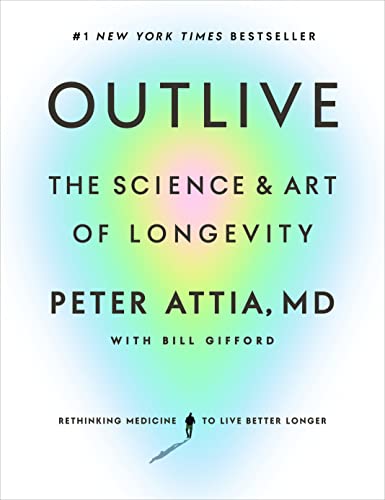
Outlive
Grounds key claims in peer-reviewed research — notably the Mandsager 2018 JAMA study (122,007 patients on VO2 max and mortality) — though many longevity recommendations extrapolate from observational data where RCTs remain thin.
Attia and Gifford sustain precision across 500 pages without padding; the emotional health chapter, where Attia discloses his own extended residential therapy, is the most unexpectedly honest section in the genre.
Medicine 3.0 — treating yourself as the n=1 subject in a multi-decade preventive experiment — reframes the patient's role; the individual pillars (exercise, sleep, nutrition) are familiar but their integration into a unified mortality-risk framework is the value.
Core Thesis
"Conventional medicine waits for disease to surface before treating — which, for the Four Horsemen (cardiovascular disease, cancer, neurodegeneration, metabolic dysfunction) that develop silently over decades, arrives too late. Medicine 3.0 treats the individual as the n=1 subject in a multi-decade preventive experiment: identify subclinical risk through biomarkers years before diagnosis, use exercise as the most potent longevity tool available, and compress morbidity into the final months rather than the final decade."
Verdict
- Must read for/if: You manage your own health actively, want to maintain high performance through your 60s and 70s, or work in medicine, coaching, or executive performance. Also worth reading in your 30s or 40s specifically — the decisions you make about exercise, metabolic health, and sleep during those decades have greater impact on your 70-year-old self than any intervention you’ll make at 65. The book’s architecture is designed for that reader.
- Skip if: You want a simple protocol in a weekend read. This is 500+ pages of clinical depth, and the protocols Attia recommends require lab work, self-tracking, and willingness to operate ahead of standard medical guidelines. If you want the condensed version, Attia’s podcast episodes on specific topics — VO2 max, Zone 2, ApoB — deliver the same rigor in focused 90-minute chunks.
- Core business value: Executive longevity is not about living to 100 — it’s about maintaining cognitive sharpness, physical capacity, and emotional stability through the peak productive decades. The diseases Attia targets are already developing in professionals in their 40s, silently, years before any symptom appears. Understanding the decade-delayed nature of the Four Horsemen changes how you think about the ROI of sleep, exercise, and metabolic health: every year of delayed intervention compounds the eventual cost.
- The reviewer’s take: Attia’s framework is the most rigorous popular synthesis of longevity science written by a practicing clinician, and the Medicine 3.0 reframe permanently changes how a thoughtful reader relates to their own health. Its structural limitation is resource intensity — the full protocol requires time, money, and access to specialized lab work that positions it squarely within affluent medicine. The emotional health chapter is the book’s most valuable surprise: a high-performing physician narrating his own breakdown, extended residential therapy, and what it cost him to ignore the fifth horseman for years.
Core Concepts
The central claim of Outlive is not that you should try to live longer. It’s that the way modern medicine is organized guarantees most people will spend their final decade in decline — and that this is preventable. Attia calls the current paradigm Medicine 2.0: evidence-based, effective at treating acute illness, but fundamentally reactive. It waits for disease to surface before treating it. For chronic conditions that develop over 20 or 30 years, that means arriving late by design.
Medicine 3.0 shifts the time horizon. It treats the individual as the n=1 subject in a multi-decade preventive experiment, uses probabilistic risk assessment rather than population averages, and calibrates intervention aggressiveness to the long development timeline of chronic disease. The patient becomes an active participant rather than a passive recipient. The physician who waits for your HbA1c to cross a clinical threshold has already missed a decade of preventive window.
The Four Horsemen account for over 80% of deaths in non-smokers over 50: atherosclerotic cardiovascular disease, cancer, neurodegenerative disease (primarily Alzheimer’s), and metabolic dysfunction (the spectrum from hyperinsulinemia through insulin resistance to type 2 diabetes). They share one characteristic: invisible development. Atherosclerotic plaques form for decades before a heart attack; Alzheimer’s pathology begins 20 years before cognitive symptoms; insulin resistance precedes type 2 diabetes diagnosis by 10-15 years. They also interact — metabolic dysfunction is the common upstream accelerator, driving endothelial dysfunction in cardiovascular disease, creating the inflammatory environment cancer exploits, and disrupting glucose metabolism in brain cells in a pattern some researchers now call “Type 3 Diabetes.”
Exercise is the primary lever. Attia draws on a 2018 JAMA Network Open study of 122,007 patients showing that low cardiorespiratory fitness carries higher mortality risk than smoking, coronary artery disease, or type 2 diabetes — and that moving from the least-fit quintile to just below-average fitness produces a 50% reduction in all-cause mortality over a decade. Elite fitness reduces mortality risk by approximately 80% compared to low fitness. VO2 max — maximum oxygen uptake during exercise — is the single strongest longevity predictor available without invasive testing.
Two training modalities drive longevity: Zone 2 and Zone 5 intervals. Zone 2 is exercise at a pace where you can hold a full conversation — blood lactate around 1.7-2.0 mmol/L. It builds mitochondrial density, improves fat oxidation, and trains the metabolic machinery underpinning cardiovascular efficiency. Attia recommends 3-4 hours per week as the foundation. Zone 5 intervals (1-2 sessions per week of high-intensity work) push VO2 max directly. Muscle mass and strength run alongside both: grip strength predicts all-cause mortality across populations and ages, and resistance training 3x per week with progressive overload is non-negotiable.
The centenarian decathlon operationalizes this framework. Identify the 10-12 physical and cognitive tasks you want to perform at 90 — climbing stairs unassisted, carrying luggage, rising from the floor — then work backward to determine what fitness level you need now to reach those targets through natural aging decline. The gap between your current capacity and the required future capacity is your training prescription: a concrete, measurable number rather than a vague aspiration.
Metabolic health is the structural foundation. Insulin resistance — the gradual inability of cells to respond efficiently to insulin — is silent for years before reaching clinical thresholds. Standard blood panels catch it late: fasting glucose only crosses the prediabetes threshold after insulin resistance is already well-established. The earlier signal is fasting insulin. ApoB — the apolipoprotein that carries every atherogenic particle — is more predictive of cardiovascular risk than LDL-C because it counts the number of particles rather than estimating cholesterol mass. Attia argues that most clinical thresholds for ApoB are set too permissively for anyone optimizing for multi-decade prevention rather than average-population risk.
Sleep is the cellular maintenance window that cannot be substituted. During slow-wave sleep, the brain’s glymphatic system clears amyloid-beta and tau proteins — the building blocks of Alzheimer’s plaques. Chronic sleep deprivation suppresses testosterone, elevates cortisol, disrupts glucose metabolism, and accelerates all Four Horsemen simultaneously. Architecture matters beyond duration: consistent timing, room temperature around 67°F for the thermal drop that initiates sleep onset, and eliminating alcohol (which fragments REM sleep without reducing total sleep time, creating the false impression of a full night).
Emotional health is the fifth horseman — the one Attia spent the longest avoiding. Chronic psychological stress activates the HPA (hypothalamic-pituitary-adrenal) axis, drives sustained cortisol elevation, accelerates visceral fat accumulation, worsens insulin resistance, and significantly elevates cardiovascular risk. The chapter in which Attia narrates his own breakdown — diagnosed with a potentially fatal cardiac arrhythmia during a period of extreme stress, followed by extended residential psychiatric therapy — is the most personal disclosure in a longevity book and the most important writing in Outlive for the high-achieving reader who treats emotional health as secondary.
Evidence Quality: Strong overall, with clear gradations. The exercise research Attia cites is among the most replicated in the medical literature — the relationship between VO2 max and mortality holds across multiple large cohorts. The metabolic health evidence (insulin resistance, ApoB, visceral adiposity) reflects mainstream cardiovascular research, though the treatment thresholds Attia advocates are more aggressive than current clinical guidelines. Sleep research supporting glymphatic clearance is strong and growing. The emotional health chapter is clinical extrapolation rather than controlled-trial evidence. Attia grades his confidence explicitly throughout and acknowledges where he’s operating at the frontier rather than the center of evidence.
Practical Applications
| Concept | Personal / Organizational Symptom | Intervention (The Play) |
|---|---|---|
| Low VO2 max | Sedentary work pattern, fatigue after short exertion, no aerobic training baseline | Target the “above average” fitness quintile for your age and sex as a first goal. Start with 3×45-minute Zone 2 sessions per week (conversational-pace cardio). Get a VO2 max ramp test to establish an actual baseline — without data, all effort is poorly directed. |
| Insulin resistance | Post-meal energy crashes, central adiposity, HbA1c drifting above 5.2, late-day cognitive fog | Measure fasting insulin, not just fasting glucose. Eliminate liquid sugar and refined carbohydrates. Add resistance training 3x per week — skeletal muscle is the primary glucose disposal organ and the most accessible metabolic intervention. |
| ApoB / cardiovascular risk | Family history of early cardiovascular disease, high LDL-C on standard panel, unresolved plaque history | Request ApoB specifically on your next lipid panel. Treat it as the primary cardiovascular risk marker. If elevated, discuss early pharmacological intervention — Attia argues that 10-15 years of subclinical ApoB elevation is far more dangerous than treating it early. |
| Muscle mass decline | Declining grip strength, difficulty with basic carrying tasks, loss of fast-twitch function after 40 | Resistance train 3x per week with progressive overload; target protein intake at 1g per pound of lean body mass per day. Test grip strength quarterly against age-adjusted norms — it is the single cheapest longevity proxy and the first functional signal to decline. |
| Sleep architecture degradation | Fewer than 7 hours consistently, alcohol use before bed, variable sleep timing, low-quality morning recovery | Enforce a 7-9 hour sleep window. Set room temperature to 67-68°F. No alcohol within 3 hours of sleep. Consistent wake time — including weekends — anchors circadian rhythm more reliably than consistent bedtime alone. |
| Chronic stress dysregulation | Reactive under pressure, persistent low-grade tension, no recovery rituals, sustained “always on” mode | Treat emotional health as a clinical variable with the same seriousness as VO2 max. Attia’s own required intervention was residential therapy — the book is explicit that productivity tactics and willpower do not address HPA axis dysregulation. Start with measurement: track resting heart rate variability (HRV) as a proxy for autonomic nervous system state. |
Practical Tips
-
Get a VO2 max test, not an estimate. Smartwatch estimates are useful directionally but imprecise. A ramp test on a bike or treadmill (available at sports performance labs and many gyms) gives you actual data: your exact percentile for age and sex, and therefore your precise mortality risk tier. The test takes 15 minutes and costs less than a routine lab panel.
-
Add Zone 2 before changing anything else. Forty-five minutes at a pace where you can hold a full sentence — not gasping, not strolling — done 3-4 times per week. Attia considers this the highest-return single intervention for most sedentary professionals, and it requires no equipment beyond a way to move at a sustained moderate pace.
-
Request two non-standard labs on your next bloodwork: fasting insulin and ApoB. Fasting glucose misses insulin resistance by design — it only elevates after the system is already under significant stress. Fasting insulin shows the compensation phase years earlier. ApoB counts the atherogenic particles that matter for cardiovascular risk where LDL-C estimates mass. Combined out-of-pocket cost: under $60. Most physicians add them without resistance.
-
Build the centenarian decathlon now. Write down 10 specific physical tasks you want to perform at 90: climbing two flights of stairs unassisted, carrying a 30-pound bag, picking something up from the floor, rising from a low couch without armrests, walking a mile. Estimate the physical capacity required for each. Then estimate how much capacity you’ll lose to natural aging between now and 90. The gap between your current numbers and the required future numbers is your training gap — a concrete target rather than a vague aspiration toward “staying healthy.”
-
Measure grip strength. A digital grip dynamometer costs $25-40. Test both hands three times, take the average, and compare against age-adjusted norms by sex. If you’re in the bottom third for your age and sex, you have a specific, fixable early warning of muscle health deficit — one that will show up in falls, frailty, and metabolic decline years before any clinical diagnosis.
Critical Analysis
Outlive is the most rigorous popular longevity framework written by a clinician with genuine research credentials, and it permanently reframes how a thoughtful reader manages their own health. Its limitation is structural: the full protocol assumes time, money, and access to specialized care that places it squarely within affluent medicine — a tension Attia acknowledges but never fully resolves.
Modern Conditions:
-
Post-pandemic health deterioration — STRONGER. Sedentary behavior increased sharply during COVID-era restrictions; metabolic health worsened across multiple population cohorts. The Four Horsemen are more relevant now than when the book published, and the fitness baseline decline across populations makes the exercise chapters more urgent, not less.
-
Wearable data — STRONGER. Apple Watch, Oura Ring, and WHOOP now provide continuous heart rate, HRV, VO2 max estimates, and sleep staging that operationalize exactly the metrics Attia recommends. The gap between “knowing this matters” and “measuring it daily” collapsed after 2023. His protocols are more executable now than they were at publication.
-
GLP-1 agonists (semaglutide, tirzepatide) — COMPLICATES. These drugs address metabolic dysfunction and obesity at a rate no lifestyle intervention matches. Attia’s framework always included exogenous molecules as a valid tool; but the GLP-1 revolution materially shifts the evidence-based hierarchy between lifestyle and pharmacology for metabolic disease specifically — a chapter the book didn’t anticipate.
Framework Gaps:
- The protocols — specialized labs, longevity clinics, precise lactate testing, elaborate exercise regimens — require time and money that are not universally accessible. The gap between the framework’s logic and what’s achievable for someone working two jobs with no gym access is enormous, and the book provides no bridge.
- Women’s health receives thin treatment. The longevity research Attia cites skews male — the VO2 max data, the cardiovascular risk thresholds, the hormonal interventions. Perimenopause and post-menopause create entirely different risk profiles, and coverage of female-specific physiology is the most notable gap for half the book’s audience.
Competing Frameworks:
- David Sinclair’s Lifespan argues aging itself is a disease caused by epigenetic dysregulation and treatable with interventions like NMN and resveratrol. Attia holds a much higher evidence bar; many of Sinclair’s molecular biology claims Attia regards as speculative. Sinclair is more ambitious; Attia is more defensible.
- Andrew Huberman’s body of work (Huberman Lab) covers many of the same protocols — sleep, exercise, stress, nutrition — with more mechanistic depth on neuroscience and hormonal biology. Huberman is more granular on individual interventions; Attia integrates them into a unified mortality-risk framework.
- Bryan Johnson’s Blueprint protocol takes Attia’s framework to its logical extreme: total biomarker-driven optimization, maximum pharmacological stack. Johnson shows where Attia’s logic leads at the limit; Attia would likely argue it optimizes the measurable while missing what makes life worth extending.