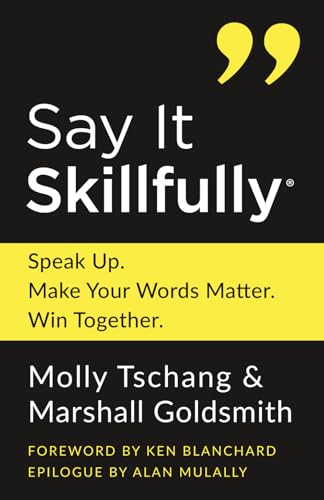
Say It Skillfully: Speak Up. Make Your Words Matter. Win Together.
Core guidance is pattern recognition from client coaching, not research. The communication data cited is vendor-sourced.
The book provides scripts for named situations — feedback upward, silence in meetings — that any professional faces.
Internal state as governor of word choice is useful, but sits within established nonviolent communication and EQ work.
Core Thesis
"Psychological safety is necessary but not sufficient — organizations leave their greatest value unrealized because people lack the skill and vocabulary to say what needs to be said, not just the permission to say it."
Verdict
- Must read for/if: Leaders managing teams where candid feedback is rare and the same problems resurface meeting after meeting; HR leaders whose psychological safety programs are producing high scores but no behavioral change; mid-level managers who frequently leave difficult conversations wishing they’d said something different.
- Skip if: You’re already fluent in Crucial Conversations, Radical Candor, or Never Split the Difference — the conceptual territory overlaps substantially. Diminishing returns if you’re already in a high-trust team where communication dysfunction isn’t a diagnosed problem.
- Core business value: The book closes a specific gap that psychological safety literature leaves open — the gap between permission and capability. People can feel safe and still lack the vocabulary and self-regulation skills to speak up. The Me-You-We framework gives any practitioner a repeatable three-step structure for entering difficult conversations without triggering defensive shutdown.
- The reviewer’s take: The central argument holds — psychological safety without communication skill is permission without capability — but the framework’s weakest assumption is universality: it treats speaking up as a skill problem when the real barrier, in many organizations, is structural, and no amount of skillful framing changes incentive structures that make honesty materially risky.
Core Concepts
The book’s central diagnostic is something most communication literature skips: psychological safety and communication skill are not the same thing. Amy Edmondson’s safety framework explains why people feel permission to speak; Tschang and Goldsmith’s work addresses why they still don’t, even when they feel safe. Safety creates the permission structure; skill delivers the actual words. The book names three fears that suppress organizational voice even in nominally safe environments: fear of being wrong (rooted in educational conditioning that rewards correct answers over honest uncertainty), fear of not fitting in (perceived disloyalty to the team’s established narrative), and fear of offending others (reluctance to deliver assessments that others don’t want to hear).
The structural solution is the Me-You-We Framework — a three-stage preparation process for entering any high-stakes conversation:
- Me: Ground yourself before speaking. Clarify your actual intention (helping vs. winning), drop emotional states that will distort your delivery (frustration, defensiveness, anxiety), and choose a tone that matches how you want to land — curiosity and confidence over irritation and certainty.
- You: Build genuine empathy for the other person’s position before opening your mouth. Ask: what does it feel like to be them right now? What constraints, fears, or pressures shape how they’ll hear your message? The exercise isn’t empathy as performance — it’s empathy as strategic intelligence.
- We: Keep the shared relationship and collective goal in view throughout. Conversations succeed when both parties finish feeling the relationship is stronger, not just that one view prevailed.
A companion concept is the Noisies vs. Quiets distinction — Tschang’s term for the visible imbalance between dominant voices and underheard perspectives in any group. She argues that any meeting participant (not just the leader) can and should correct this imbalance actively, by naming the dynamic and creating space for quieter voices. This reframes communication as a shared system responsibility, not a leadership-only function.
The book also introduces a three-level Relationship Intelligence model — relationship with self (emotional grounding), relationship with others (empathy), and relationship with the team system (collective dynamics) — drawn from Tschang’s Organization & Relationship Systems Coaching (ORSC) certification, where team relationships are treated as entities with their own patterns and needs.
Case discipline: The book’s most instructive case is Tschang’s own story — a shy, non-native English speaker who joined Cisco as an engineer and learned communication as a deliberate practice, eventually managing the integration of 80+ acquisitions across multiple continents. This case proves one important thing: communication confidence is acquired, not innate, and the skill is learnable across personality types. It proves less than it implies. Tschang’s trajectory at Cisco and U.S. Filter involved structural advantages — seniority, institutional authority over integration decisions — that provided material cover for early missteps. The book doesn’t address how the same toolkit performs for a 24-year-old analyst without positional leverage who disagrees with a decision made four levels above them.
Evidence quality close: Say It Skillfully is practitioner-driven, not research-driven. The frequently cited $1.2 trillion miscommunication figure comes from Grammarly’s State of Business Communication Report — a vendor-commissioned study, not an independent academic source. The Me-You-We framework is built from Tschang’s 25 years of executive coaching and Goldsmith’s behavioral change methodology, corroborated by endorsements from senior practitioners (Blanchard, Mulally, Kraemer) rather than peer-reviewed evidence. The Gallup 85% disengagement figure is a real finding from ongoing global research but represents baseline organizational malaise, not a communication-specific effect. The framework is coherent and the practitioner base substantial; readers expecting empirical validation will find an argument from authority rather than an argument from evidence.
Practical Applications
| Concept/Dysfunction | Organizational Symptom / Trigger | Leadership Intervention (The Play) |
|---|---|---|
| Unsaid truths — fear of speaking up | Meetings conclude with consensus; individuals privately disagree. The same issues resurface at every retrospective. | Before each significant meeting, explicitly surface the stakes: “I want to hear from people who see this differently — silence here costs us later.” Then call on Quiets by name: “Alex, what are we missing?” |
| Noisies vs. Quiets imbalance | Two or three voices dominate discussion; the rest observe. Decision quality narrows because the range of perspectives contracts. | Any participant (not just the facilitator) can intervene: “We’ve heard from a few people — I want to make sure we hear the whole room before we commit.” No position power required to say this. |
| Psychological safety without communication skill | Team scores high on trust surveys but avoids hard conversations in practice. Feedback sessions produce vague, non-specific observations. The same behavioral issues repeat quarter after quarter. | Train the Me-You-We prep sequence explicitly before difficult conversations. Make the process visible: “I’ve been thinking through how to say this — let me share my intent first.” Naming the process reduces the other person’s defensive anticipation. |
| Feedback that triggers shutdown | Performance conversations produce defensiveness, disengagement, or silence. Behavioral issues persist because feedback never lands cleanly. | Lead with permission and framing: “This might be hard to hear, but if I were in your shoes, I’d want to know. Can I share an observation?” Wait for a genuine yes. Then: one specific behavior, one specific impact, one specific ask. Nothing else. |
| Managing up without voice | Mid-level managers withhold concerns from leadership; executives make strategic decisions with incomplete ground-level information. | Frame disagreement as information-sharing, not opposition: “I may be missing context — I’m seeing X on the ground and want to understand how that fits your decision.” Curiosity is less threatening than correction, and often surfaces the real constraint faster. |
Practical Tips
-
Run a pre-conversation Me-You-We check: Before your next difficult conversation, spend 90 seconds writing answers to three questions: What’s my actual intention? What is the other person likely feeling right now? What do I want us both to walk away believing about our relationship? If you can’t answer all three, reschedule. If after two weeks of applying this your conversations are shorter but less productive, you’re using it as a delay mechanism — skip straight to the We step next time.
-
Count the Noisies and Quiets in your next three meetings: Keep a tally of who speaks and who stays silent. After each meeting, approach one Quiet privately and ask: “You seemed to have something on your mind — what was it?” Compare their answer to what was said in the room. If the gap is large and consistent, you have a structural safety problem, not a skill problem — Me-You-We won’t fix it alone.
-
Test the permission open: In your next feedback conversation, use Tschang’s framing verbatim: “This might be tough to hear, but if I were in your shoes, I’d want to know — can I share something?” Note whether you get a genuine yes or a performative one, and whether the person’s defensiveness before and after delivery differs measurably. If you consistently get performative yeses that collapse into shutdown after delivery, the frame isn’t the issue — examine your tone and the relationship baseline before the conversation begins.
-
Apply the humble-plus-confident calibration: Record yourself in one meeting or call this week. Listen back for moments where your tone lands as either arrogant (certain beyond the evidence) or deferential (ceding a position you actually hold). Label each instance. If you find more certainty than evidence supports, your audience is likely tuning you out before the content lands. If you find more deference than your actual view warrants, you’re training colleagues to discount what you say.
-
Disagree out loud in your next group setting: When you hold a minority view and the room is moving toward consensus, say: “I notice we seem aligned — I see it differently and want to put that on the table before we commit.” Don’t wait for a formal process. If this produces visible discomfort or redirection rather than genuine engagement, what you’ve learned about the culture is more valuable than the specific idea you were advocating.
Critical Analysis
Say It Skillfully succeeds where most communication books fail by naming a structural gap — the distinction between psychological safety and communication skill — and providing an executable framework to close it. But the framework’s universality claim is its most consequential assumption, and it does not survive contact with real organizational power dynamics.
STRONGER in remote and async-first environments. The book’s insistence on intentional preparation before speaking has more value when conversations happen in writing — a Slack thread or email gives you the time to run the Me-You-We process before sending. The noisies/quiets dynamic also intensifies in digital formats, where staying silent costs nothing and dominant voices compound over time. Framework applicability: STRONGER.
WEAKER where power asymmetries are structural. The book treats speaking up as a skill problem when it is often a structural one. A junior employee in a punitive culture who learns to frame disagreement as “perspective-sharing” still faces real career consequences for contradicting someone four levels above them. Tschang and Goldsmith acknowledge fear as a barrier, but the proposed solution — better preparation and framing — works when the risk is misperception rather than retaliation. In the latter case, no amount of skillful delivery changes the incentive structure. The framework is silent on this distinction. Framework applicability: WEAKER.
NEUTRAL for individual contributors without positional authority. The tactical framework is most naturally read by managers and leaders. The Noisies/Quiets intervention and the managing-up guidance both require a degree of perceived permission that junior contributors may not experience as genuinely available to them. Framework applicability: NEUTRAL.
Gap 1 — No failure taxonomy. The book names three fears but applies one solution set. Real-world communication failures cluster differently: some are tone failures, some are timing failures, some are structural misalignments between organizational incentives and honest speech. A more rigorous framework would differentiate intervention by failure type rather than applying Me-You-We as a universal starting point.
Gap 2 — The receiver’s role. Tschang frames speaking skillfully as the speaker’s responsibility. Much organizational silence is produced by bad listening — leaders who react badly to honest input train their teams to stay quiet regardless of how skillfully the input is packaged. By ignoring this, the book leaves unaddressed the question of what happens when skillfully delivered communication lands with a leader who isn’t ready to receive it.
Competing frameworks: Crucial Conversations (Patterson et al.) covers similar territory with more developed protocols for the moment when dialogue breaks down. Radical Candor (Scott) adds an explicit power-dynamics lens that Say It Skillfully underplays. Thanks for the Feedback (Stone & Heen) addresses the receiver side this book underweights. By engaging none of these directly, Tschang and Goldsmith miss the opportunity to name their distinctive contribution precisely: the Me-You-We self-regulatory preparation stage, which Crucial Conversations assumes but never teaches. That’s the real differentiator — and it goes unnamed.
Quotes
“You can be both: clear and kind. That's where real trust lives.”
“If people don't have the skill to speak up without it feeling too risky, it doesn't matter how safe it is — they will still stay silent.”
“The lack of shared reality — not being on the same page about the facts and the human experience — is the number-one barrier to performance.”
“Your communication is how others fundamentally experience you.”