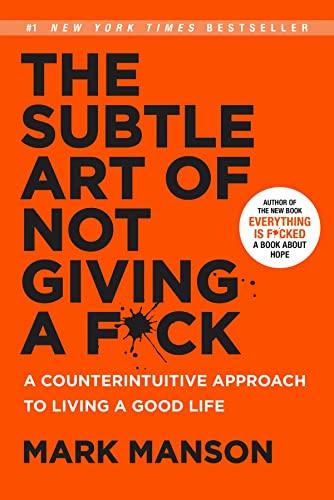
The Subtle Art of Not Giving a F*ck
Every argument runs through anecdote; no cited studies appear and no disconfirming cases are engaged anywhere in the book.
The book offers three checks for stuck goals — struggle test, metric audit, Do Something — all self-diagnostic with no guided process.
Mustaine and Pete Best shared the same outcome but lived opposite inner lives — judging by metric rather than achievement is the sharper frame.
Core Thesis
"A good life is built not on positive thinking or achievement but on good values — choosing deliberately what deserves your finite attention and care, embracing rather than fleeing the struggles those values require, and taking radical responsibility for how you respond to everything."
Verdict
- Must read for/if: People stuck in a self-improvement consumption loop who feel worse about themselves the more content they consume. Manson’s diagnosis is that the problem is bad values, not insufficient information — and for readers trapped in that specific loop, this reframe actually lands. Also useful for anyone who knows what they should do but can’t figure out why they won’t.
- Skip if: You want empirical grounding or a rigorous psychological framework. This is personal essay with philosophical scaffolding, not research-backed argument. If you’ve read Viktor Frankl’s Man’s Search for Meaning or engaged Stoic philosophy seriously, you’ll find the intellectual core familiar and the sourcing thin.
- Core business value: The “choose your struggle” reframe is the most practically useful idea in the book: it shifts the evaluative question from “what outcome do I want?” to “what kind of pain am I willing to sustain?” That single question cuts through a significant amount of goal-setting theater, distinguishing commitments people will keep from outcomes they merely fantasize about. The responsibility/fault distinction — something can be not your fault but still your responsibility — is equally applicable to any stuck situation.
- The reviewer’s take: The book is a skillful popularization of ideas running from Stoic philosophy through Camus through modern psychology. Manson is a talented translator, not an original thinker, and he rarely credits his intellectual sources. The profane, funny, self-deprecating voice is the actual product: those who respond to it will find the ideas stick in ways that Seneca or Frankl didn’t. Those who don’t will find the book thin. Neither group is wrong.
Core Concepts
Manson’s central mechanism is what philosopher Alan Watts called the “backwards law”: the desire for positive experience is itself a negative experience, and the acceptance of negative experience is itself a positive one. Pursuing happiness as a goal amplifies the felt absence of it. The person who desperately wants to stop being anxious feeds the anxiety loop. This isn’t passivity — it’s a reorientation of what the pursuit is actually for. The book’s opening argument is that the entire self-help industry runs the backwards law in the wrong direction: every “be happier, be more successful, be better” message begins by reminding you of everything you currently lack.
The operative metaphor is the fuck budget — attention and care are finite, and you are always allocating them to something, whether you choose consciously or not. Most people distribute that allocation reactively, attaching to whatever their culture, advertisers, or immediate social environment signals as important. The book’s project is to make that allocation conscious. Giving fewer fucks doesn’t mean caring about nothing — it means reserving care for what actually matters by your own examined values, and letting the rest go without internal drama.
Values and metrics are the machinery under the hood. Every value is measured by a metric — the yardstick by which you judge success or failure. Dave Mustaine founded Megadeth after being kicked out of Metallica, sold 25 million albums, became one of heavy metal’s legends, and still considered himself a failure in a 2003 interview because his metric was “more successful than Metallica.” Pete Best, the original Beatles drummer who was also fired, ended up by his own account happier — because he eventually reprioritized his metric around family and a quiet life. Same objective outcome; radically different lives, driven by different values and metrics. Manson’s taxonomy of bad values: pleasure, material success, always being right, constant positivity. Good values are reality-based, internally achievable, and immediately controllable by your own behavior. The distinction isn’t about the content of the value so much as whether the metric lies within your own jurisdiction.
The responsibility/fault distinction is the book’s most practically transferable idea. Something can be not your fault and still be your responsibility. Philosopher William James, suicidal in his late twenties after years of failure and illness, ran an experiment: he spent one year treating himself as fully responsible for everything in his life, regardless of cause. He went on to become the founder of American psychology. Manson calls this the most radical form of self-development — not because it’s fair, but because it’s the only variable actually under your control. Blaming circumstances is an accurate description of your situation that makes you powerless to change it. Accepting responsibility is an inaccurate description that gives you power.
The book ultimately argues for choosing your struggle rather than choosing your desired outcome. Most people want the reward without the process — the physique without the training, the relationship without the difficult conversations, the business without the grinding early years. The clarifying question isn’t “What do you want?” It’s “What pain are you willing to sustain?” That second question predicts what someone’s life will actually look like, not the first. Alongside this, Manson proposes the Do Something principle: motivation does not precede action — it follows it. The conventional model is Inspiration → Motivation → Action. The actual loop is Action → Inspiration → Motivation → Action. If you’re stuck and waiting for motivation to arrive before you begin, you’ve misunderstood causation.
Evidence Quality: Essentially none. Manson argues through personal narrative and anecdote: Bukowski, Mustaine, Pete Best, William James, Hiroo Onoda fighting WWII alone in the Philippine jungle until 1974. These stories illustrate the thesis; they don’t test it. The psychological concepts he invokes — hedonic adaptation, cognitive bias, pain as feedback — are real, but he cites no studies and engages with no disconfirming cases. The book’s authority rests entirely on whether the anecdotes resonate and the voice lands.
Practical Applications
| Concept/Dysfunction | Symptom / Trigger | Intervention (The Play) |
|---|---|---|
| Reactive fuck allocation | Outsize emotional investment in outcomes outside your control — social media feedback, others’ opinions, luck-dependent results — while high-value relationships and work receive depleted attention | Audit where emotional energy actually went this week. List three things that consumed disproportionate anxiety. For each, ask: “Is the metric I’m using reality-based and within my own control?” If not, name a replacement metric for the same underlying value. |
| Bad value / bad metric | Measuring success against a fixed external benchmark — like Mustaine measuring himself against Metallica — that makes achievement feel permanently out of reach regardless of actual progress | Write down the three main ways you judge success in your most important life domain. Test each: Can I achieve this through my own behavior alone? Is it based on reality rather than perception? If not, rewrite the metric. “Write with greater clarity each month” is controllable; “be considered the best writer in my field” is not. |
| Denial or victim stance | Treating problems as fixed external conditions (“I can’t because…”) rather than as situations requiring a response; outsourcing the diagnosis to circumstances | Apply the responsibility/fault split: identify one problem you’ve been treating as not your responsibility. Write down what it would look like to accept full responsibility for your response to it — not the cause, just the response. Take one action in that direction today, before motivation arrives. |
| Happiness as destination | Waiting to feel satisfied before engaging fully with work; treating current dissatisfaction as an obstacle rather than a signal | Shift the question from “What outcome do I want?” to “What processes do I find genuinely engaging?” Plan your next ninety days around those processes, not the outcomes. The outcomes follow or they don’t; the process is the only thing you can actually live in. |
| The feedback loop from hell | Feeling bad about feeling bad — anxious about anxiety, guilty about guilt — which compounds the original negative state rather than resolving it | Recognize the meta-emotion for what it is: not information about reality, but a self-amplifying loop. The intervention is observing the negative emotion without the additional layer of judgment: “I’m anxious. That’s fine. Anxiety is normal.” The loop stops when you stop feeding it the second-order reaction. |
Practical Tips
-
Run the struggle test. For any goal you’ve been pursuing for more than six months without significant progress, ask Manson’s clarifying question: “What pain am I willing to sustain for this?” If the honest answer is “not much,” the goal isn’t yours — it’s a fantasy you’re attached to because the outcome looks appealing. Drop it, or find the version of the work you actually want to do.
-
Audit your metrics. Write down how you currently measure success in your most important life domain. Run each metric through three checks: (1) Is it reality-based, not based on feelings or perception? (2) Is it based on my own behavior rather than others’ judgments or luck? (3) Could I make progress on it starting today, without external conditions changing? Replace any metric that fails two or three of those checks.
-
Act before you feel ready. The Do Something principle means that motivation is a byproduct of action, not a prerequisite. When stuck — on a project, a decision, a change you know you need to make — start with the smallest viable action, not the action that would feel most meaningful. Redesign one page before redesigning the whole site. Send one email before rewriting your strategy. The act generates the momentum; waiting for motivation extends the paralysis.
-
Name the value, not the feeling. When sustained negative emotion shows up, push past “I feel bad” to identify the underlying value and the metric generating the feeling. “I feel inadequate because I haven’t shipped anything this week, and I’ve been measuring my worth by output” gives you something actionable. The feeling is the readout. The value and metric are the settings that can actually change.
Critical Analysis
The Subtle Art of Not Giving a F*ck is the most commercially successful Stoic philosophy primer of the past decade — which is both its real achievement and its natural limit. The voice and packaging made ideas that had lived in Meditations and Man’s Search for Meaning accessible to people who would never pick those books up. But the book’s deliberate anti-intellectualism prevents Manson from engaging seriously with where his argument runs thin or contradicts itself.
Modern Conditions:
-
Attention economy saturation — STRONGER. The book arrived in 2016, before the full acceleration of algorithmic content designed to capture attention at the cost of everything else. The problem Manson describes — reactive fuck allocation, giving a fuck about whatever the culture tells you to — has grown significantly more acute since. The fuck budget concept is more practically urgent against infinite scroll than it was in 2016.
-
Performative wellness culture — STRONGER. The self-improvement industry Manson critiques has expanded dramatically: mindfulness apps, productivity systems, morning routines, journaling frameworks. Much of this industry is precisely what the book warns against — a high disguised as a solution, creating the feeling of working on yourself without the discomfort of examining your values. Manson’s critique lands harder against 2025’s landscape than it did at publication.
-
Mental health normalization — MIXED. The mainstreaming of therapy and trauma-awareness has made some of Manson’s framings feel dated (“emotions are overrated” sits poorly against contemporary understanding of nervous system regulation), while making others more applicable — the distinction between treating negative emotions as data versus as identity is now more widely understood and easier for readers to act on.
Framework Gaps:
- Manson’s responsibility doctrine — taking full responsibility for your response to everything — is psychologically sound for people suffering ordinary dissatisfaction. It can be genuinely harmful advice for people in abusive systems, where accepting full responsibility for your response translates into staying in situations that require leaving. The book doesn’t make this distinction, and the failure is not incidental: it flows directly from the framework’s design.
- The “choose your struggle” framing assumes a menu of options that not everyone has. Someone in poverty, systemic disadvantage, or acute crisis doesn’t face the same range of available struggles that Manson implicitly assumes. The book was written from and for a position of relative freedom, and that assumption is invisible to it.
Competing Frameworks:
- Viktor Frankl’s Man’s Search for Meaning makes the same core argument — that meaning is found through freely chosen suffering — with empirical grounding, far greater intellectual rigor, and from a context (Auschwitz) that makes the insight undeniable rather than lifestyle-advice-adjacent. Anyone genuinely moved by the book’s central idea should go to Frankl next.
- Albert Ellis’s REBT (Rational Emotive Behavior Therapy) provides the clinical framework for exactly the mechanism Manson describes informally: suffering comes not from events but from irrational beliefs about those events, and there is a structured, empirically validated process for identifying and changing those beliefs. Manson’s anecdotes are more readable; Ellis’s framework is more useful.
- Ryan Holiday’s Ego Is the Enemy covers adjacent territory — the obstacles created by unhealthy attachment to self-image — with more consistent intellectual sourcing and cleaner organizational applications. The two books together cover more ground than either alone: Holiday addresses ego-driven perception failures at every career stage; Manson addresses value-driven metric failures in everyday life.