Howard Marks
Co-founder of Oaktree Capital Management, best known for his frameworks on market cycles, risk, and second-level thinking.
About
Howard Marks built his reputation not through a single trade or a celebrated short, but through writing. Since 1990, he has sent investment memos to Oaktree Capital’s clients — analytical letters on markets, risk, cycles, and investor psychology. Those memos are now among the most widely read documents in the investment industry. When Warren Buffett said “When I see memos from Howard Marks in my mail, they’re the first thing I open and read”, it reflected what institutional investors had known for years: Marks writes with clarity and honesty about difficult questions that most practitioners avoid.
Born in New York in 1946, Marks trained at two of the strongest finance programs in the country — undergraduate at the Wharton School and an MBA from the University of Chicago Booth School of Business. He spent his early career at Citicorp Investment Management before joining TCW Group in 1985, where he ran high-yield bond and distressed debt portfolios. In 1995, he co-founded Oaktree Capital Management with six partners. Oaktree grew into one of the world’s largest alternative investment managers, with assets under management approaching $170 billion, concentrating in distressed debt, credit, and real assets — markets that reward patience and analytical precision over momentum.
The core of Marks’s investment philosophy is a rejection of the comfortable assumption that superior returns come from finding good assets. His argument: in competitive capital markets, good assets are already priced to reflect their quality. Superior returns come from finding assets priced below their value — a distinction that requires second-level thinking (not “is this good?” but “does the market know it’s good, and is it priced correctly?”) and a risk-first mental model that asks “what’s the downside, and can we survive it?” before asking about the upside. That framework runs through every memo, every lecture, and both of his books.
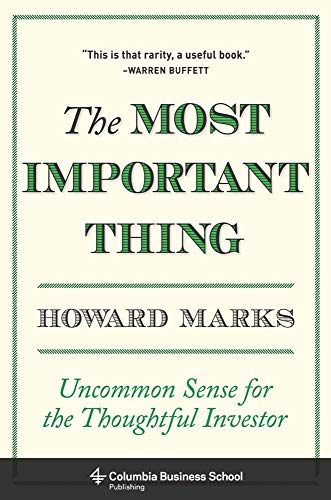
The Most Important Thing (2011), expanded in an illustrated edition in 2013 with commentary from Joel Greenblatt, Seth Klarman, and others, compiled two decades of that thinking into a coherent philosophy. His second book, Mastering the Market Cycle (2018), extended the framework into a detailed analysis of cycle recognition — how to identify where markets sit in the greed/fear oscillation and how to adjust portfolio positioning accordingly. Both books read less like investment manuals and more like documents from someone who spent decades thinking carefully about what he could and couldn’t know — and built a practice around that honesty.